To The Banks of the Zambezi and Beyond
Railway Construction from the Cape to the Congo (1893-1910)
The following extended feature is adapted from 'To The Banks of the Zambezi and Beyond - Railway Construction from the Cape to the Congo (1893-1910)', researched and written by Peter Roberts and first published in 2021.
To The Banks of the Zambezi
Rhodes presented details of his grand scheme to extend the railway to the Zambezi and beyond at a meeting of the Chartered Company’s shareholders in London on 21st April 1898. He summarised in typically blunt terms:
“I want two million pounds to extend the railway to Lake Tanganyika - about 800 miles [1,287.5 km]... Look at the matter. You get the railway to Tanganyika; you have Her Majesty’s Government’s sanction for a railway to Uganda, and then you have Kitchener [and his railway] coming down from Khartoum [in the Sudan]. This is not imaginative: it is practical. It gives you Africa... the whole of it!” (Strage, 1973)
Many in London were shocked by his ambitious plans and the Government did not respond positively, possibly because more than half of Africa was already under the control of rival European nations across whose territory it would have to travel. City investors however were more interested, although not everyone shared Rhodes’ enthusiasm for the project.
“Sir William Harcourt, who thoroughly detested Rhodes, thought the scheme hair-brained, and never hesitated to say so. He was staggered, therefore, to find a Welsh steel mill hard at work manufacturing rails for the Cape to Cairo railway.” (Rhodesia Railways Magazine, November 1957)
With the extension of the railway to Bulawayo and opening of new horizons the board of the Bechuanaland Railway Company, under the chairmanship of Cecil Rhodes, decided to rename the construction company and on 1st June 1899 the Rhodesia Railways were born (Croxton, 1973).
Routes to the River
The consultant railway engineers Sir Douglas Fox and Partners had originally envisaged the route north would cross the Zambezi River over the Kariba Gorge, some 350 kilometres downstream of the Victoria Falls, before continuing north to the east of Lake Tanganyika. Sir Charles Metcalfe surveyed a possible route to the river in 1898.
“As to the extension northwards my first idea was to go towards the Kariba Gorge, where coal was reported to be found (for no part of the railway was made for sentimental reasons), but on examination the coal was shown to be very inferior, and I had to report against the route.” (Metcalfe, 1923)
In September 1899 the Bulawayo Chronicle reported a surveying team was sent by Sir Charles to survey the middle sections of the Zambezi for a potential crossing.
“Mr T E Phillips, who left Bulawayo a short time ago, has been sent northwards by Sir Charles Metcalfe to examine the country along the Zambesi, together with the nature of its banks for a certain stretch, commencing about 100 miles [161 km] below Wankie’s. The object of this survey is to gather reliable information, from which it may be ascertained where a likely spot exists for the crossing of the Cape to Cairo railway, to give it its grandiose name, or the Gwelo northward extension, to give it its local name...
“It is practically certain that the line will cross at a point below the junction with the Kafui. It is hoped that a suitable crossing may be found not far from such junction, as on the other side a high plateau of great extent is situated, which would be easy of traverse and healthy; this plateau according to all reports is an extremely fertile one and eminently suited to stock raising and agriculture...
“The difficulty of finding a suitable crossing place is, however, very great, as the Zambesi runs to such an extent in steep gorges that it is no easy task to get at it for bridging purposes. The great desideratum is of course to find a spot where there is an easy approach and where a narrow span will suffice.” (Bulawayo Chronicle, September 1899)
The country between Kariba and Lake Tanganyika, however, was found to be unfavourable terrain for the railway, and the search for a suitable crossing point and onward route for the railway continued.
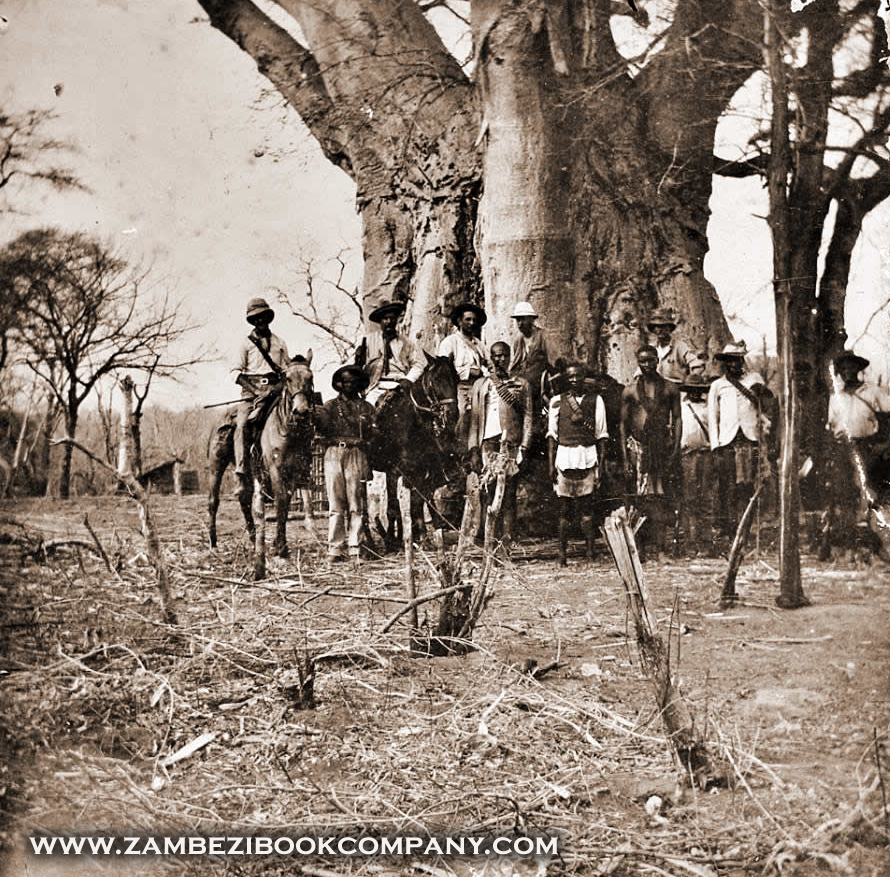
Sir Charles Metcalfe’s surveying party, Kariba 1898
The Line to the Falls
In November 1899 it was reported that provisional surveying of the proposed line to the Victoria Falls was underway. At the time the line was to terminate at the Falls, with the Railway Company still looking for a potential crossing point further downstream for the line to the north.
“An important piece of work is soon to be commenced, namely the survey of the extension of the route for the line northwards to the Victoria Falls. In a few days Mr D Chester, with Messrs Mageoan and Jeffroys start north to be accompanied by about ten natives, with probably two wagons. The time they will be away will of course depend on their rate of progress and that will depend on the nature of the country which is largely an unknown quantity. The season is hardly the best one to choose for a start, but the railways have to be pushed on at all costs.” (Bulawayo Chronicle, November 1899)
By April 1900 two of the three survey teams on the line to Falls had finished their fieldwork and were preparing the final plans for the line.
“Two out of three surveying parties have completed their surveys, and are back in town preparing plans and sections for the line. The third survey party is still out, but is expected back shortly.” (Bulawayo Chronicle, April 1900a)
The first surveying team, lead by Mr Tower, had a relatively easy task, but the second team, led by Mr Rosher, had a more challenging terrain to cover.
“The survey party whose duty it was to survey and stake out the second section of the railway north to the coalfields, set out from Bulawayo on the 7th of January and got back here on the 7th of April, accomplishing their labours after overseeing difficulties which were, if not unparalleled, at any rate arduous in the extreme. Most people after reading the account which follows, who desire to go to the Victoria Falls, will prefer to wait until the line is completed to Wankies and will be well advised in so doing, unless they are old pioneers or attached to an extremely well-equipped expedition.
“The second section survey party consisted of Messrs Rosher, Manson, James and Salmon, the first named being in charge. They had with them two wagons and a Scotch cart, and 22 boys. Provisions were take sufficient to last about nine weeks. The objective of the party was a point computed to be 130 miles [209 km] north-west of Bulawayo by the flying survey, and this point reached, the party was to work south until they joined on to the first section. The journey up was expected to take less than a fortnight, but from various causes actually occupied five weeks...
“The surveying point for the south was situated in a pan in very open country, and the course of the line was laid out perfectly straight for 40 miles [64 km], adding on to 20 miles [32 km] of straight line, staked out by Mr Rees of the third section party, which was working north. This bit of line, all but sixty miles [96.5 km], which total it lacks by a few links only (about 10 feet [3 m]) is believed to be the longest straight in South Africa, and therefore a record. The grass in the open country was enormously high and strong; it averaged about 10 feet [3 m] high, and one stalk was measured and found to be 13½ feet [4.1 m] long. After five miles [8 km] of open country, the party began to pierce the forest, and here the difficulties began. The trees were from 1 foot to three feet [30-91 cm] in diameter, and many were in the direct line, so had to be cut down to allow a sight with the theodolite. One tree trunk which directly barred progress measured in diameter 4 feet 4 inches [1.3 m], and took seven hours to cut down. This belt of forest was 26 miles [42 km] wide. About the middle water began to be very scarce, and on one occasion the boys and water cart were out two days and three nights in search, and one boy got lost in the veld and was brought in by the white men, a raving lunatic. He was ill all the way back, but eventually recovered, though getting into Bulawayo almost a living skeleton. Water was luckily discovered in a pan about nine miles [14.5 km] from camp. It was green in colour, but the party were thankful to get it, drinking through their handkerchiefs. Their thirst assuaged, the rest was afterwards boiled...
“On the way back the road, though still bad, was better, but one night dwells in the memory of the party. One wagon was stuck in a drift south of the Gwaai, rain came on and fell all night, and the surveyors had to sleep in the mud up to their ankles without blankets. On another occasion three teams of 16 oxen and one of 14 (one team having been hired and another borrowed) could not move the wagon, which was only carrying 2,000 lbs. [907 kg]. There was nothing for it but to offload and carry the stuff. This was in black veld where it took the two teams 11 days to move six miles [9.6 km], and the earth was up to the back axles.
“The party found an excellent crossing of the Gwaai, and joined on to Mr Tower’s section about four miles [6.4 km] south of the Gwaai... After completing the work the return journey, some 70 miles [112.6 km] or more, was covered in 15 days, but the roads were rather better and the wagons light.” (Bulawayo Chronicle, April 1900b)
A Change of Plan
In August 1900 the Bulawayo Chronicle published details of a significant shift in the plans for the railway to the north.
“It appears that the original idea of running two lines northwards to the Zambesi from Bulawayo has been altered. It will be remembered that the main line, commonly called the Cape to Cairo railway, was to be continued through Gwelo in an almost directly northern direction to the Zambesi. Thence the line was to continue passing Lake Tanganyika on the eastward side, and thus passing through German territory. Another line was to be laid to the Victoria Falls, via Wankies, tapping the vast coalfields in the last mentioned district, and stopping at Victoria Falls for the present.
“In all probability, however, the last named line will be the main line to the north, and instead of stopping at the Falls, the line will be carried across a little below where the river narrows, instead of running to the east of Lake Tanganyika, the railway will go west through the Congo Free State, the west coast belonging to that State, the east to German East Africa, and the south to British Central Africa. The line will pass between the Lake and the sources of the mighty Congo... It by no means follows that the Zambesi is not to be crossed later on at a point considerably to the east as originally intended by an extension via Gwelo. But for the present this will remain in abeyance... The length of the line to Wankies will be some 200 miles [322 km], and thence to the Falls another 80 miles [129 km] or so.” (Bulawayo Chronicle, August 1900)
References
Bulawayo Chronicle (September 1899) Cape to Cairo Railway - Crossing the Zambesi. 30th September.
Bulawayo Chronicle (November 1899) Northern Extension - Important Work to be Commenced. 18th November.
Bulawayo Chronicle (April 1900a) The line to Wankies. 7th April.
Bulawayo Chronicle (April 1900b) Railway Surveying in Rhodesia, 21st April.
Bulawayo Chronicle (August 1900) Cape to Cairo Line - Altered Plans. 25th August.
Croxton, A. H. (1982) Railways of Zimbabwe. David and Charles (Publishers) Ltd. [Originally published as Railways of Rhodesia, 1973].
Metcalfe, Sir C. (1923) My Story of the Scheme - The Story of a Famous Engineering Feat. [In Weinthal, L. [Editor] (1923), Vol.I]
Rhodesia Railways Magazine (November 1957) ‘Cape To Cairo’ Scheme Still A Dream. Vol.6, No.7, p.31. [BRMA]
Strage, M. (1973) Cape to Cairo. Jonathan Cape.
- Go back to the feature section index.
Now available to order through Amazon UK/US sites.

The author can order copies for overseas orders outside of these areas (and with discounts for multiple copies) - please see the Contact Us page.