To The Banks of the Zambezi and Beyond
Railway Construction from the Cape to the Congo (1893-1910)
The following extended feature is adapted from 'To The Banks of the Zambezi and Beyond - Railway Construction from the Cape to the Congo (1893-1910)', researched and written by Peter Roberts and first published in 2021.
Through the Wilds to Hwange
In April 1903 a second contract was agreed for the construction of a further 46 miles (74 km) of railway terminating near the Hwange coal mines. The cost for this contract was £2,872 per mile, no doubt due to the much more difficult terrain encountered on this section.
Reports record Pauling employing some 2,500 labours on the line. Reporting to Mr Townsend on the progress of the line was Mr Charles Beresford-Fox, Assistant Resident Engineer for the Railway Company (and nephew of Sir Douglas Fox). Mr Beresford-Fox would be involved with the development of the line to the Falls and preparations for the Bridge.
Mr Samuel Burns, one of the many Europeans recruited by Pauling on the construction, worked on the line from Bulawayo and is believed to have died of blackwater fever near Hwange (Burns, 2018).
Mr W A Sicklen was employed by Pauling on the railway construction from 1898 and worked on the line north for nearly ten years until 1907. In mid-1921 Mr Sicklen recorded his memories of railway building in a newspaper article widely syndicated at the time.
“I may here say the eight-hour day didn’t count, neither did the go-slow policy. It was a case of work like hell, very often under the great hardships which are incidental in opening up and pioneering a new country such as this... The sleepers, which are of steel, being carried from the material train and laid on the already prepared foundation. The rails were then carried out and laid on the sleepers, then came along the linking-in gang, who turned the rails into the lugs of the sleepers. The fishplates were then put on, and two of the four bolts tightened up, and the train then moved ahead to the end of the rails.”
“I will now try and give a short description of every-day work. Up at daylight, a cup of tea, plate-laying train ready for railhead with material; cooks and workmen all aboard; for breakfast 30 minutes, dinner 45; back at camp at 7 or 7:30 in the evening, and a hot tea of meat, potatoes and vegetables; smoke and turn in.” (The Blue Mountain Echo, May 1921)
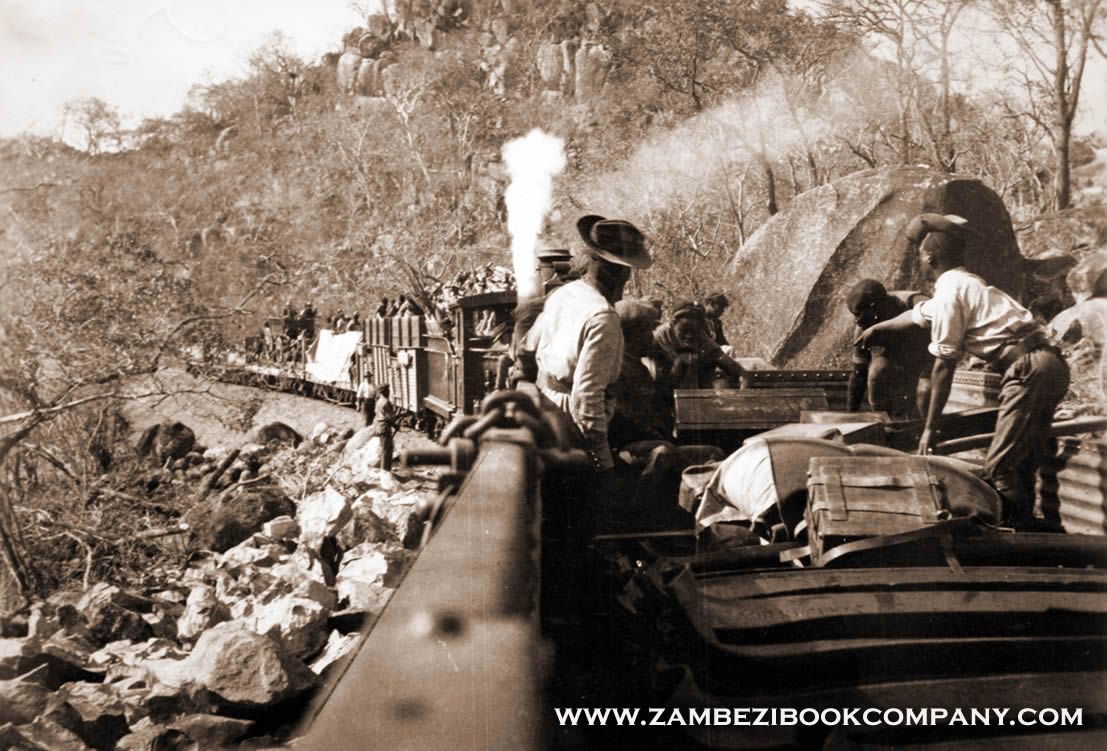
Construction materials on the way north
Mr Knight’s Travel Notes
In late 1902 Mr Edward F Knight, Special Correspondent with the London based Morning Post, was sent out from England to tour southern Africa and report on the state of the territories after the Boer War, travelling north to the Victoria Falls in May 1903.
“On the morning of May 4th I left Bulawayo by train for the railhead, which I reached after a thirteen hours’ journey across a monotonous wilderness of bush. At the railhead a feverish spot, people say, and haunted by lions there is a railway-construction camp, which will shortly be moved further on as the line advances. I found the vaunted coach standing amid the dense bush. It was an ordinary Cape cart, battered with use on the roughest of roads, with broken brake and broken hood and otherwise dilapidated...
“Behind the cart and also in front of it, extending well along the dissel-boom, the mail-bags for the North and a mass of transport of all sorts boxes, bales, barrels, and what not were lashed, while the body of the cart was piled high above the seats with a miscellaneous cargo. And now on the dizzy summit of this top-heavy mass the four passengers had to hook on, somehow, themselves, their baggage, and their provisions for four days...
“The ten oxen were inspanned, and about midnight we drove off into the pitch blackness of the night for there was no moon and with a cart so marvellously overladen we anticipated almost certain disaster. I must explain that things are not always as bad as this. It was my ill luck to make the journey under exceptionally uncomfortable conditions... But the tourist must be prepared to have rough experiences. My three fellow passengers were all old pioneers and transport riders, ...and none knew better what rough travel meant, but all agreed that this was the hardest and most fatiguing journey they had ever made, and they needed a rest when we reached Livingstone.
“But I understand that this section of the road is no longer the terrible track I found it. The management of the Wankie Collieries represented that, as its material was often delivered in a very damaged condition, it would have to await the coming of the railway and cease to import anything but necessaries by waggon unless the road to the railhead was greatly improved. The result has been that the task of making the road more practicable for transport was entrusted to a contractor, who engaged a gang of boys and expeditiously cleared the boulders from the worst places on the way and otherwise patched it up, so that now it is unrecognisable, and for the thirty-five mile section between the railhead and Wankie the traveller proceeds with relative smoothness of motion...
“This was one of the dustiest journeys possible throughout; but here we came to the dustiest part of it all, a weird bushland, where the soil was pitch black. For nearly a league we travelled through a deep, soft, very fine black powder like soot, which rose in dense clouds under the oxen’s feet...
“Having crossed the plain of black dust, we rounded some low kopjes and opened out a valley enclosed by steep heights. The white men’s buildings, for the most part of corrugated iron, were scattered over the hill sides, and from some tall chimneys in the valley bottom volumes of black smoke were pouring, a strange sight to come across thus suddenly in these wilds. This was Wankie, and the mail cart, after mounting a hill, outspanned outside the house of Mr Price, the general manager of the mines, which overlooks the whole settlement...
“From Wankie we continued our journey along the vile road in our rickety cart, halting occasionally to effect repairs whenever a tyre fell off a wheel, or the harness parted, or some other portion of the vehicle began to tumble to pieces. But we tied it all together somehow with ‘reims,’ and to our astonishment safely crossed the boulder-bristling precipitous drifts and dongas...
“On our fourth and last night of the journey we outspanned for a while at a stage to change the oxen, and, as we lay down on the ground outside the cattle kraal to get a few minutes’ sleep, we clearly distinguished, our ears being near to the earth, a low noise like the distant roaring of the sea, and we knew that we were listening to the sound of the mighty cataract, now about sixteen miles [25.7 km] away. It was dawn when we inspanned and commenced the last stage of our journey. As we neared the Zambesi the roar ever increased in volume, and soon, on reaching the summit of a high ridge, we saw, far off, on the level horizon, a great white silver-edged cloud, the only one in the blue sky. There is the ‘smoke,’ said my companions, who had made this journey before. It was the famous spray cloud that everlastingly hangs over the Victoria Falls.” (Knight, 1903)
Stage by Stage
By August the line had reached Lukosi, 29 miles (46.6 km) from Mambanje.
“The railway to Wankie is making fairly rapid progress, and it falls to the lot of Mr C H Zeederberg to keep pace with it and take immediate advantage of the completion of each section. He has to adapt himself to a continual change of conditions and, in conjunction with Messrs Pauling, Ltd, afford the public with quicker service as time goes by.
“A number of interests not exactly identical have to be served and arrangements devised which shall fit each component part into its place, producing on the whole a better result... and on his last trip Mr Zeederberg had to complete arrangements to suit the change of railhead from M’banji’s 166 miles [267 km], to Lukosi, 29 miles [46.6 km] further on, or 195 miles [314 km]...
“Lukosi, the new railhead, is in the midst of a forest composed of very thick bush, and a new road had to be cut to the old one. This has been done, and the journey to Wankie is proportionally shortened, as the remaining 15 miles [24 km] is over a good road, with good water and good veld, points of great importance where transport is concerned. A clearance of the bush has also been afforded at Lukosi to enable wagons to be comfortably loaded and easily turned round...
“The journey to Wankie now being considerably shortened, Mr Zeederberg is forwarding about 40 tons of transport a day from Lukosi, the bulk of which is for Wankie. Preparations had been made for expeditions forwarding by means of 30 wagons, which were in readiness, and a large gang of natives. Transport is handled by oxen and mules, the latter of which were taken up by Mr Zeederberg, and they are negotiating three round trips a week.
“When the line reaches Wankie, which is expected about the end of September, the bulk of the transport will be finished, but there will still be considerable quantities to go forward for the Northern Copper Company, the Government, missionaries and the trading stations in the north.
“There will be a lot of back work to do after the line reaches Wankie, such as grading the long rock cutting and building culverts.
“The road north of Wankie is being improved by a road party and as soon as the line arrives at Wankie Mr Zeederberg will put on a service of saloon coaches.
These will cover the distance to the Falls, about 85 miles [136.8 km], in two days, allowing passengers a rest at an accommodation house, to be erected half-way. Tourists and visitors will then find the Falls easily accessible from Bulawayo, and the traffic may be expected to show considerable increase.” (Bulawayo Chronicle, August 1903)
Progress was international news and plans to continue the railway to the Falls as soon as Hwange was reach were well advanced.
“English papers state that steps have been taken to begin immediately the construction of the section of the Cape-to-Cairo Railway between Wankie and the Zambesi at Victoria Falls and that 2,500 labourers will at once commence work on this section. Railhead will be at Wankie, about 200 miles [322 km] northwest of Bulawayo, very shortly... The removal of the light rails on the Vryburg-Mafeking section is rapidly proceeding, and, according to the latest advices, 42 miles [67.5 km] out of the total 96 [145.5 km] had been relaid with 60-pound [27.2 kg] rails.” (American Science, August 1903)
Hwange Reached
The advancing rails reached Hwange, 212 miles (341 km) from Bulawayo and 2,448 ft. (746 m) above sea level, in early October 1903. Such was the demand for coal that the first train loads were dispatched south later the same month, with the line still under construction conditions. The line was officially opened for traffic on 1st December with onward passengers and mail transferred to the Zeederberg coach service for the remaining 68 miles (109.5 km) to the Victoria Falls.
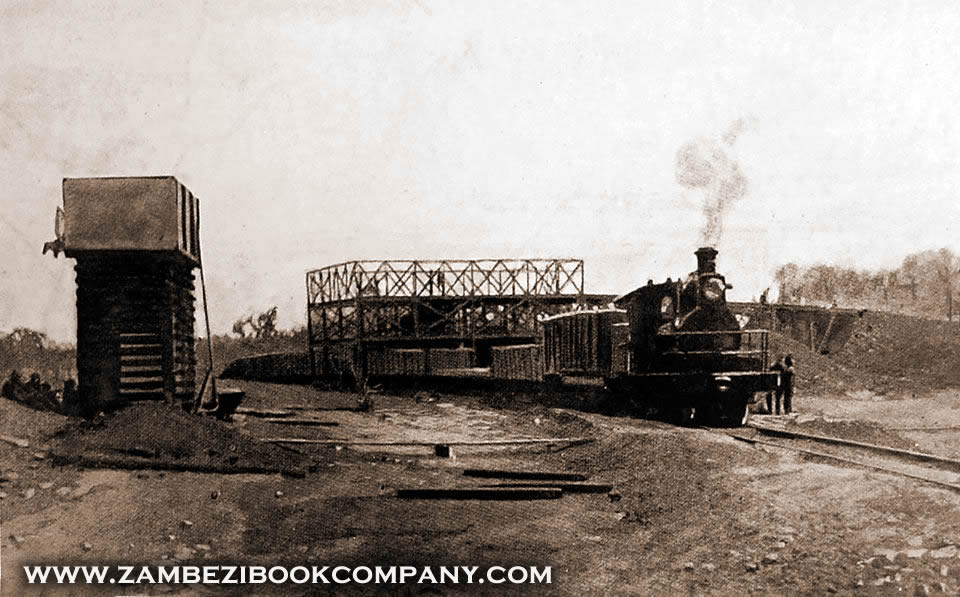
First train at Hwange loading coal for the south, October 1903
The final surveying work on the third section of line, from Hwange to the Victoria Falls, had started in September 1903, with the contract only finalised and signed in December. Construction continued at an agreed contract price of £2,350 per mile and with a bonus of £7,500 for Pauling and his men in the event of the rails being suitable for the passage of trains by 1st April 1904.
Sir Charles Metcalfe reported to the press that the Falls would be reached by the following April. Plans for a grand hotel at the Falls, to accommodate one hundred guests, were apparently well advanced.
“It is estimated by Sir Charles Metcalfe that by April next the Falls will be reached, and a few weeks or months later passengers will be able to travel by Pullman car to a spot that twenty years ago was hardly known. The few people who have yet been able to visit these marvellous Falls agree in describing them as one of the greatest wonders of the world and it is not surprising to learn that the promoters of the railway are making the usual arrangements for exploiting this great natural wonder.
“A large hotel is to be built at a convenient distance, capable of accommodating one hundred guests, and on either side of the river land is to be reserved for a great park. It is obvious that even people who go to look at waterfalls must eat and drink, and to that extent some sort of hotel is necessary, but there may be a danger of overdoing the comforts of civilisation. Already in Switzerland many of the most beautiful places have been partly spoilt by the erection of giant hotels that are necessarily out of character with the general scene. Sir Charles Metcalfe appears however, to be conscious of this danger, and it is to be hoped that he will insist that both the railway and the hotel are kept sufficient distance from the Falls to prevent the vulgarisation of the greatest waterfall in the world.” (The Auckland Star, December 1903)
References
American Science (August 1903) Vol XVIII, No. 454, p.352.
Bulawayo Chronicle (August 1903) Bulawayo to the North - Some Improvements. 15th August.
Burns, B. (2018) Personal communication with author, February.
Knight, E. F. (1903) South Africa After The War - A Narrative Of Recent Travel.
The Auckland Star (December 1903) News, Views and Opinions. 12th December. [Online source available here]
The Blue Mountain Echo (May 1921) Cape-Cairo Railway - First Engine over the Zambesi. 6th May. [Online source available here]
- Go back to the feature section index.
Now available to order through Amazon UK/US sites.

The author can order copies for overseas orders outside of these areas (and with discounts for multiple copies) - please see the Contact Us page.