To The Banks of the Zambezi and Beyond
Railway Construction from the Cape to the Congo (1893-1910)
The following extended feature is adapted from 'To The Banks of the Zambezi and Beyond - Railway Construction from the Cape to the Congo (1893-1910)', researched and written by Peter Roberts and first published in 2021.
The Line North
During 1891 Rhodes came under increasing pressure in the Cape parliament over the delay on extending the railway to Mafeking. With resources channelled to developing the line from the east coast, the Chartered Company was short of capital and keen to delay committing to construction until absolutely necessary.
“At best it could follow the suggestion of George Pauling, the Company’s railway contractor, that they should at least start the railway, making ‘a good show with the earthworks... just to keep the Cape public quiet.’ But even this expense was too great a burden during such troubled times.” (Maylam, 1977)
By mid-1892 the position had become one of increasing embarrassment for Rhodes, and plans were at last advanced to raise the funding for the construction. The Bechuanaland Railway Company was formed in May 1893 with the backing of the Chartered Company and with Rhodes as chairman Pauling was finally invited to formerly bid for the Vryburg to Mafeking contract.
“We had some differences as to the price to be paid, and I understood that we had as competitors the firm of Messrs Lucas and Aird. I was not satisfied with the price suggested by the consulting engineers for this work and made another tour over the route, after which I decided upon terms and ultimately, through Mr Rhodes, I entered into a contract (which I remember was signed at midnight after a dinner at which Sir Charles Metcalfe and I were the guests of Mr Rhodes) with the Bechuanaland Railway Company, Ltd. The fulfilment of their obligations was guaranteed by the British South Africa Company, and its construction, extending to 106 miles [170.5 km], was completed in the following year. This section is of especial interest to me inasmuch as it is the commencement of what is known as the Rhodesian railway system, with the construction of which I have since been so closely connected.” (Pauling, 1926)
Costs were eventually agreed and the contract signed, with George Pauling’s cousin, Harold William Pauling, overseeing the construction - a role he would assume all the way to the Victoria Falls.
“As regards the Vryburg-Bulawayo line, Harold Pauling, George’s cousin, was appointed as agent in charge of construction of the line... The House of Erlanger joined them, and once George had taken over the Departments of Mines and Public Working in Rhodesia and was thus preoccupied, Baron d’Erlanger’s son Emile took over as Chairman.” (White, 1973)
From Vryburg to Mafeking
On 10th May 1893 Pauling’s men started work on the extension of the Cape line northwards from Vryburg to Mafeking, a distance of 96 miles (154.5 km), undertaken at a contracted rate of £2,575 per mile (Knight, 1900).
“Mafeking in 1893 was, like Vryburg four years earlier, an uninteresting frontier settlement consisting mainly of corrugated iron stores round the regulation market square. It enjoyed a certain importance owing to its proximity to the Transvaal border (on which account it was the headquarters of a considerable body of mounted police), and it was the most advanced depot for the north, and the point where hunters, traders, and prospecting parties fitted out their expeditions for the far interior... Still, the prospect of a railway created a temporary bustle, and storekeepers and hotel proprietors began to arrive, while township plots, as well as farms along the line, were eagerly snapped up by speculators.” (Marshall-Hole, 1923)
Mr Harold Pauling oversaw the construction for Pauling and Company, with Mr Stephen F Townsend as Chief Resident Engineer for the Railway Company and Mr William Tower his assistant. Mr Townsend, who had been employed by the Cape Government Railway and personally appointed by Rhodes, would work on the construction of the line north to the Zambezi and beyond. Mr Tower was in charge of the surveying for the line north.
“Mr W Tower was chief assistant engineer to Mr Townsend [Chief Resident Engineer] and in charge of most of the surveys north from Vryburg... As assistants at the start of the works he had Mr C Everard and Mr Beresford Fox, a son of Sir Francis Fox, one of the consulting engineers in London.” (Varian, 1953)
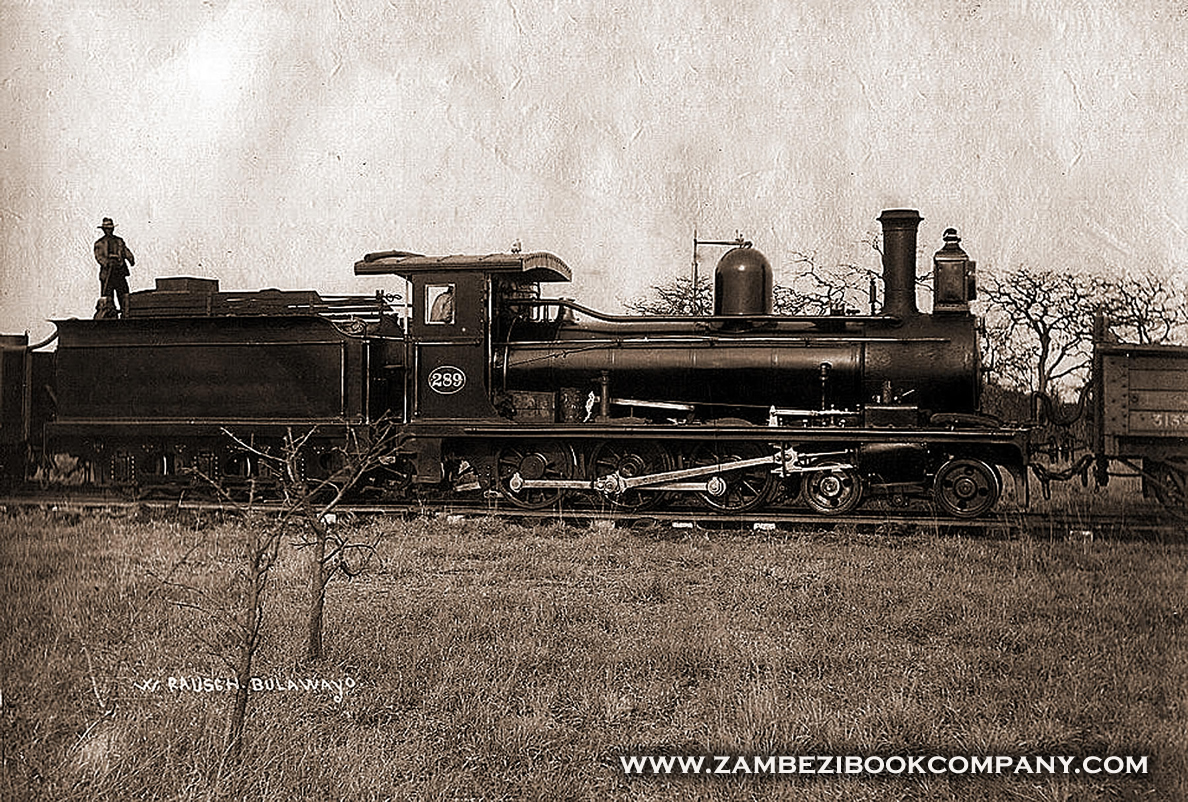
Engine No.289, used by Pauling and Co on the construction from Vryburg
The country was fairly easy terrain for the construction gangs.
“The ninety-six miles [154.5 km] of line from Vryburg to Mafeking were of easy construction and boasted at that time a stretch of straight line thirty-three miles [53 km] long, from a siding named Paradise - possibly so named by the overjoyed engineer surveying the route - this being then the second longest piece of straight line in South Africa. Most of the route was on high plateau, devoid of bush but excellent for stock raising and grain, and was to become popular with farm settlers. From Maribogo through Kraaipan and Maritzani the country was undulating with occasional seasonal rivers which gave trouble when in flood.” (Croxton, 1982)
The line was initially laid with 45 lb. (20.4 kg) rails, the contract requiring completion of the line within 18 months of the start date.
“Work on the Vryburg-Mafeking section commenced on the 10th May 1893. The gauge of the line is 3 feet 6 inches, which is the same as that of the Cape Government Railways. Steel sleepers have been used, and the rails are of Bessemer Steel weighing 45 lbs. [20.4 kg] to the yard. The contractors were bound to complete within 18 months from the date of the contract.” (British South Africa Company, 1892-94)
The line to Mafeking, 870 miles (1,400 km) from the Cape, was officially opened 3rd October 1894.
“Since the date of the last Report the construction of the Bechuanaland Railway Company’s line from Vryburg to Mafeking, a distance of about 100 miles [161 km], has been uninterruptedly pushed forward by the contractor and Resident Engineer. The line, in which the Chartered Company is largely invested, was built well within the contract time, and, after inspection by Engineers on behalf of the Imperial and Cape Governments, was on the 3rd October last, publicly opened by Sir Sidney Shippard, Administrator of British Bechuanaland, and the Hon John Laing, Commissioner of Cape Government Railway.” (British South Africa Company, 1894)
Rhodes, as ever, had his eye on a bigger prize than just satisfying the conditions of the Charter, although for once his plans would be frustrated. In November 1894 Rhodes was to write to the Secretary of State for the Colonies:
“Had it not been for the expectation that at no distant date the Bechuanaland Protectorate would be directly administered by the Chartered Company, it is needless for me to say that my whole policy of railway extension would have been a different one. I should certainly not have undertaken the construction of the railway from Kimberley to Vryburg, nor should I have subsequently extended that line from Vryburg to Mafeking, nor at this moment should I be engaged in arranging for its further extension northwards of Mafeking.” (White, 1973)
References
British South Africa Company (1892-4) Report Company’s Procedures and Condition of Territories, 1892-94. [Cawston Papers, Bodlien Library]
British South Africa Company (1894) Directors Report and Accounts. 31st March. [Cawston Papers, Bodlien Library]
Croxton, A. H. (1982) Railways of Zimbabwe. David and Charles (Publishers) Ltd. [Originally published as Railways of Rhodesia, 1973].
Knight, J. H. (1900) The Cape-To-Cairo Railway. The Engineering Magazine. Vol XIX, No.1, April 1900, p.1-18.
Marshall Hole, Lieut.-Col. H. (1923) The Rhodesian Railways [In Weinthal, L. [Editor] (1923), Vol.IV]
Maylam, P. R. (1977) The Making of the Kimberley-Bulawayo Railway : A Study in the Operation of the British South Africa Company. Journal of Rhodesian History. Vol.8, p.13-33.
Pauling, G. (1926) Chronicles of a Contractor, Constable. [Reprinted 1969 Rhodesia Reprint Library Vol.4, Bulawayo. (Edited by David Buchan)]
Varian, F. H. (1953) Some African Milestones. George Ronald, Wheatley.
White, B. (1973) The Trailmakers, The Story of Rhodesia Railways. Supplement to Illustrated Life, Rhodesia, 31st May.
- Go back to the feature section index.
Now available to order through Amazon UK/US sites.

The author can order copies for overseas orders outside of these areas (and with discounts for multiple copies) - please see the Contact Us page.