To The Banks of the Zambezi and Beyond
Railway Construction from the Cape to the Congo (1893-1910)
The following extended feature is adapted from 'To The Banks of the Zambezi and Beyond - Railway Construction from the Cape to the Congo (1893-1910)', researched and written by Peter Roberts and first published in 2021.
The Line at Bulawayo
Preparations at the Palace
The eager expectations of the residents of Bulawayo were growing by the day, and formal planning for the celebrations ahead soon well advanced.
“With railway construction moving apace, representatives from the Sanitary Board, the Chamber of Mines, the Chamber of Commerce, and the Rhodesian Land Owners and Farmers’ Association held discussions during July to consider arrangements for suitable festivities to mark the occasion of the formal opening of the railway to Bulawayo. On 21st July, Captain the Hon A Lawley, Deputy Administrator, presided over a well-attended meeting of representative public men held in the Stock Exchange to further plans for the festivities. It was later settled that the opening of the railway would take place on Occupation Day, 4th November.” (Bolze, 1968)
The proprietor of the Palace Hotel, Mr W R Paterson, had succeeded in winning the contract for the accommodation of the 300 invited guests for the opening festivities, despite the fact that his hotel was still only partially built.
“It was reported at a Chambers of Commerce meeting that on 23rd August the rails were 8½ miles [13.5 km] within the border of Rhodesia. Meantime the Railway Festivities Committee, which had been joined by Col. H M Heyman and Dr Hans Sauer, had concluded a provisional programme. It announced that estimated subscriptions and guarantees for this programme would amount to about £9,000. Invitations to 340 special guests were being sent out that week and the contract for their accommodation was awarded to Mr W R Paterson, proprietor of the Palace Hotel.
“Any scepticism Bulawayans may have had regarding the town’s ability to extend adequate hospitality to the considerable number of guests for the opening ceremony - the original list had grown after applications for invitations had been received from numbers of influential people - must have been allayed after publication of a one-and-a-half column long news item detailing the arrangements made by Mr Paterson for accommodating and feeding the guests. At that date - 23rd September - the hotel was still being built. Going up to three storeys it stood like a giant in the southern portion of the town.
“Mr Paterson had just returned from a three-week trip to Port Elizabeth and Kimberley to hurry forward all the extra building material, fittings, furniture and food required. From the list of articles ordered and referred to in the news report it was evident that his shopping list had been extremely comprehensive. Among the items ordered to furnished the 130 bedrooms were 250 spring mattress beds, 500 feathered pillows, 800 sheets, woollen blankets and counterpanes, candle-sticks, mirrors, toilet sets, bedroom tables, etc. ‘He will deepen his well... erect about a dozen bathrooms and has ordered tins and towels and brushes galore - of towels alone he had ordered 1,000. After the bath, many of the visitors will naturally require a shave, and a number of professional razor wielders will perform this operation for them on the premises.’
“‘Of foodstuffs he had ordered about 1,500 cases of tinned items, 200 turkeys, as many ducks and as many geese, besides 600 fowls, 400 dozen eggs and so on. Fresh fish was to come up from Port Elizabeth and fresh fruit from Kimberley. The visitors will want something to drink with all this and therefore an order has been given which among other lubricants includes 100 cases of whisky, 150 of champagne, 65 of beer and 20 of lime juice.’ He was erecting a temporary dining and banqueting hall to seat some 400 people and it would be suitably floored for dancing.
“‘For the convenience of visitors wishing to visit the local battle-fields and other places of interest, he had ordered 12 large picnic-baskets.’ Also on the indent were 400 cane-bottomed chairs, 800 hat-and-coat hooks, 48 Madeira easy chairs, a dozen rocking chairs and at least two pianos. Special arrangements were made for the railway trucks containing the goods, and labelled ‘Railway Festivities,’ to be speeded on their way by the Traffic Managers at Port Elizabeth and Kimberley, by Mr Pauling and the Station Master at Francistown...
“By the end of September both the Railways Festivities Committee and the railway construction contractors were working at pressure to have things ready for 4th November. Mr Townsend’s weekly report stated that the contractors were putting nearly all their energies into pushing plate-laying, and not much else attended to. This had been delayed for a whole week for the want of fish bolts. Meantime the Festivities Committee had arranged with Mr Zeederberg to run two coaches a day for the eight days of the festivities to the Mattoppos. Visitors would breakfast at Mr Rhodes’ farm, and thereafter proceed to ‘the World’s View.’” (Bolze, 1968)
The Rails at Bulawayo
In early October 1897 Harold Pauling updated the Committee of the Bulawayo Chamber of Commerce on the imminent arrival of the railway.
“Mr Pauling anticipates that the rails will be laid to Bulawayo on the 20th of this month. During the ensuing five days they will be occupied in carrying forward the material for the temporary goods and passengers stations, &c. From the 25th October he will be able, he thinks, to carry general goods forward for the public to a temporary siding, half a mile from the present station site.” (Bulawayo Chronicle, October 1897a)
The final section of the extension, Francistown to Bulawayo, 122 miles (196 km), was completed in mid-October 1897. The first construction train, pulled by the same engine that had been used for the plate-laying of the line from Lobatsi, No.289, arrived at Bulawayo on 19th October 1897. Decorated with flags it carried the banner ‘Advance Rhodesia’ on the front, surmounted by the arms of the Chartered Company.
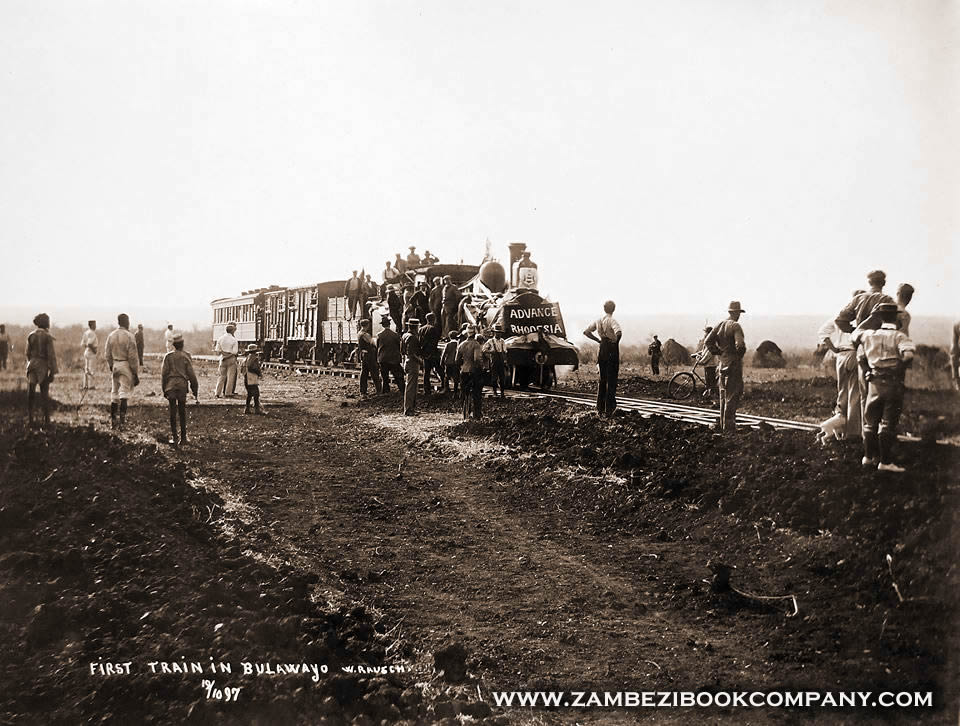
The construction train arrives at Bulawayo
“A Chronicle reporter went out to the old B.A.C. ground on Tuesday afternoon shortly after two and sat with a number of others on the bank between the cuttings to await the arrival of the first construction train. The work of laying the rails which have now advanced some distance to the town side of the refreshment room, was going on cheerily and expeditiously at the feet of the expectant watchers. All eyes were turned towards the rise to the south of the town over which it was known the train must travel, Suddenly someone said ‘There she comes!’ Everyone rose to his feet, and could just discern a faint column of smoke over the crest of the rise. It advanced rapidly, and presently the train emerged from the bush and became visible, a shrill whistle demonstrating to another sense its approach almost at the same time...
“The engine, the same one that has been used for the platelaying all the way up from Lobatsi, was gaily decorated with bunting and greenery. On the front were the words ‘Advance Rhodesia,’ surmounted by the Arms of the B.S.A. Company. Miniature Union Jacks, Stars and Stripes, and Harps of Erin adorned the escape pipe, and a variety of flags were wreathed gracefully round other portions of the iron monster. The passengers by the first train included: Mr H W Pauling, Mrs Pauling, the Misses (2) Pauling, Dr Pauling [Dr William Pauling, another cousin of George Pauling], Mr R B Carnegy and Mr Buchan, one of the engineers of the Bechuanaland railway. The train also brought some of Mr Pauling’s horses, a quantity of timber for the temporary buildings at the station site, and some miscellaneous goods. The rear trucks having been detached, the train moved slowly to the old B.A.C. ground... The train came to a standstill and the engine responded to the cheers with a series of shrill whistles.” (Bulawayo Chronicle, October 1897b)
Mr Gates stood on the front of the engine as it arrived, thus claiming to be the first man to arrive by train (Bulawayo Chronicle, October 1955). Mr Rosher also travelled on the train and was responsible for the coloured plaque with the arms of the British South Africa Company placed on the headlamp of the engine (Rhodesia Railways Magazine, September 1969).
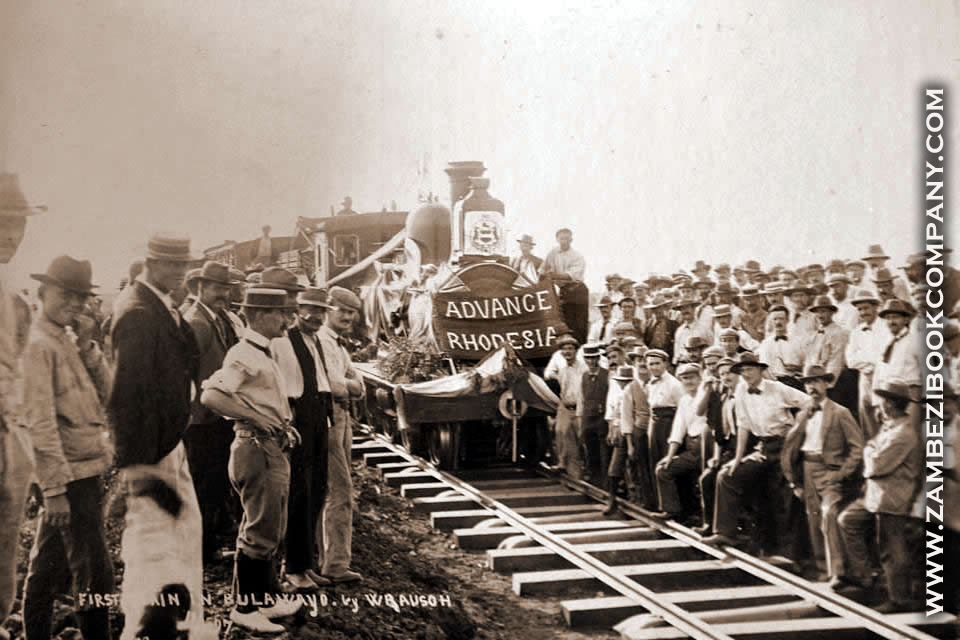
The crowrd gather around the engine
“After gazing a while on the wonderful invention, which brings Bulawayo within four or five days of sea breezes and makes progress with giant strides a possibility, the crowd dispersed. It is probable that the railway will not be taken over by the Cape Government until the end of the year. But it is here at last. The contractor, despite immense difficulties, has accomplished his work well under the specified time, and coaches and wagons along the great artery from Capetown to Bulawayo are almost things of the past.” (Bulawayo Chronicle, October 1897b)
The 588 miles (946 km) of line from Vryburg to Bulawayo was built between May 1893 and October 1897 at a total capital cost of just over £2,270,628, or £3,681 per mile (Bolze, 1968). The efficiency of construction was remarkable considering that all the construction material and rolling stock had to be shipped from England and then transported by rail for over a thousand kilometres to the advancing railhead (Jones, 1997).
Will and Determination
The arrival of the line at Bulawayo, 1,360 miles (2,176 km) from Cape Town and 4,468 ft. (1,361m) above sea level, was a landmark event in the colonial development of the interior. The railway established a vital communication and transport route to and from the south, bringing an end to the town’s isolation.
“The first section, that from Mafeking to Mochudi, 123 miles [198 km], was opened to traffic on 1st March 1897, and from there the remainder of the line was built with extraordinary energy: Mochudi to Palapye, 136 miles [219 km], opened on 1st July 1897: Palapye to Francistown, 101½ miles [163 km], on 1st September 1897; and Francistown to Bulawayo, 122 miles [196 km] on 4th November 1897.” (Croxton, 1982)
Driven by Rhodes’ will and the determination of George and Harold Pauling, the railway to Bulawayo was opened a year earlier than the original contract date, establishing the much needed lines of communication and transportation which the pioneer settlement needed to survive. At the time when Rhodes gave the command to press forward the railhead was 492 miles (792 km) from Bulawayo, with Pauling overseeing the construction of nearly 500 miles (804.5 km) of railway in 400 days.
“In completing 400 miles [644 km] of new railway in twelve months to the date of the arrival of the first train at Bulawayo, Harold Pauling had performed a feat to go down in the annals of railway history.” (Croxton, 1982)
By mid-October excitement for the awaited official opening was fast reaching fever pitch. The Bulawayo Chronicle recorded:
“The time is now drawing near for the great celebration, and there is no doubt that it will be a unique event in the history of Matabeleland... The country has been advertised all over the world. Bulawayo is as much as household name as London or Vienna... and the prospects of Matabeleland have been made known wherever the English language is spoken... The celebration is nothing more or less than a challenge to the outside world. We ask our detractors to come out to the country to see for themselves what we have to show in the latest addition to the British Empire.” (Bolze, 1968)
References
Bolze, L. W. (1968) The Railway comes to Bulawayo. Rhodesiana, No.18, July, p.47-84.
Bulawayo Chronicle (October 1897a) Mr Pauling Interviewed. 7th October.
Bulawayo Chronicle (October 1897b) The First Train. 21st October.
Bulawayo Chronicle (October 1955) Laid Line and was first in. Unknown date.
Croxton, A. H. (1982) Railways of Zimbabwe. David and Charles (Publishers) Ltd. [Originally published as Railways of Rhodesia, 1973].
Jones, D. (1997) 100 Years The Railway in Zimbabwe 1897-1997. Pangolin Press, Harare.
Rhodesia Railways Magazine (September 1969) A Railway Pioneer, Mr Edward M Rosher, a Tribute to his Memory. Croxton A. H. Vol.18, No.5, p.16. [BRMA]
- Go back to the feature section index.
Now available to order through Amazon UK/US sites.

The author can order copies for overseas orders outside of these areas (and with discounts for multiple copies) - please see the Contact Us page.