To The Banks of the Zambezi and Beyond
Railway Construction from the Cape to the Congo (1893-1910)
The following extended feature is adapted from 'To The Banks of the Zambezi and Beyond - Railway Construction from the Cape to the Congo (1893-1910)', researched and written by Peter Roberts and first published in 2021.
Crossing the Zambezi
In 1901 the Rhodesia Railways board gave the go ahead for the railway extension to the Zambezi, crossing the river immediately below the Falls. In May the Illustrated London News reported.
“The Cape to Cairo Railway will cross the Zambezi River at the Victoria Falls, approximately 300 miles [483 km] north-west of Bulawayo. It would appear as though a foreseeing providence had arranged the matter, for only a few hundred yards below the Falls, and at the commencement of a wonderful gorge that goes twisting away for thirty miles [48 km], the railway engineers have chosen a spot where a single span of 600 ft. [182.8 m] will bridge the whole river. All the exposed banks of river, chasm, and gorge are of solid black basalt, substantial material to found the piers upon; and we believe it is intended to employ as little superstructure as possible in the construction.” (The Illustrated London News, May 1901)
The original examination and selection of the site for the Bridge was carried out by Sir Charles Metcalfe in June 1901, who reported that it would not present any insuperable engineering problems (Rhodesia Railways Magazine, November 1965). Rhodes, despite never visiting the Falls, had been clear where the Bridge was to be built. Mr G A Hobson, credited with designed the Bridge, recorded in his report on the construction of the Bridge to the Institute of Civil Engineers in 1907:
“In 1901... [Rhodes] was shown at his office in London a sketch of the bridge it was then proposed to build. Although he had never visited the locality, he was sufficiently familiar with it from travellers’ descriptions and engineers’ surveys to indicate in a general way the point of crossing. He determined that passengers in the trains going over the bridge should have a view of the Falls; and as the site on which the bridge now stands is practically the only one which could fulfil this purpose, it may be said to have been chosen by him... The preliminary design of the bridge above referred to was prepared to meet Mr Rhodes’s views, and it received his approval.” (Hobson, 1907)
The final choice of site was governed by the natural formation of the rock walls of the Batoka Gorge, advantage being taken of the minimum distance to be spanned, combined with the soundest foundations obtainable. Sir Charles returned to England to raise funds for the project, but as news of the site of the Bridge reached London, there was an outcry.
“The site chosen had given rise to much adverse criticism both in England and in Africa, the critics saying that such a natural wonder as the Falls should not be allowed to be desecrated by any of man’s handiwork - that the bridge ought not to be within sight of the cataract.” (Prince, 1906)
The Bulawayo Chronicle Christmas Annual of 1901 contained an artist’s impression of the Bridge, in full colour and with the caption ‘a glimpse into the near future,’ which provoked much local disbelief, partially due to the artistic licence taken with the subject matter (Rhodesia Railways Magazine, July 1955).
Back in England an article published in The Times newspaper claimed the finished Bridge would be “a blot on the landscape.” At least one reader agreed, noting in a letter to the paper: “That man Rhodes,” is a “vandal” and a “desecrator of all that is beautiful in nature” (Rhodesia Railways Magazine, August 1955). The African Review later recorded:
“There were not wanting people who suggested that to bridge the gorge at all would be an act of vandalism, and Sir Charles Metcalfe and his assistants... came in for a great deal of unpleasant criticism.” (South Africa Magazine, April 1905)
Sir Charles would later write “no part of the railway was made for sentimental reasons,” but the Victoria Falls Bridge is the one exception to his statement. As Frank Varian, an engineer who worked on the Bridge and railway line north later observed:
“The choice of its site was more for sentiment than for practical reasons... A simpler crossing could have been achieved six miles [9.6 km] further up, [near Kandahar Island] where the longest span need only have been 150 feet [45.72 m].” (Varian, 1953)
Hobson maintained that the site chosen was the best possible for the Bridge.
“I am of the opinion that it is the best possible position for a bridge near to the Falls. The very beauty of the spot has, however, created objections to its selection. The situation is briefly this: The scene is laid within the tropical zone. At a place where the river is a mile in width, the bright and lovely Zambezi, whose gentle rippling waters flow sparkling in the sun, is precipitated suddenly into a dark chasm which lies square across its path, and through only one constricted outlet down below the whole body of water forces its agitated way into a narrow deep and sinuous gorge beyond. The bridge crosses this gorge.” (Hobson, 1923)
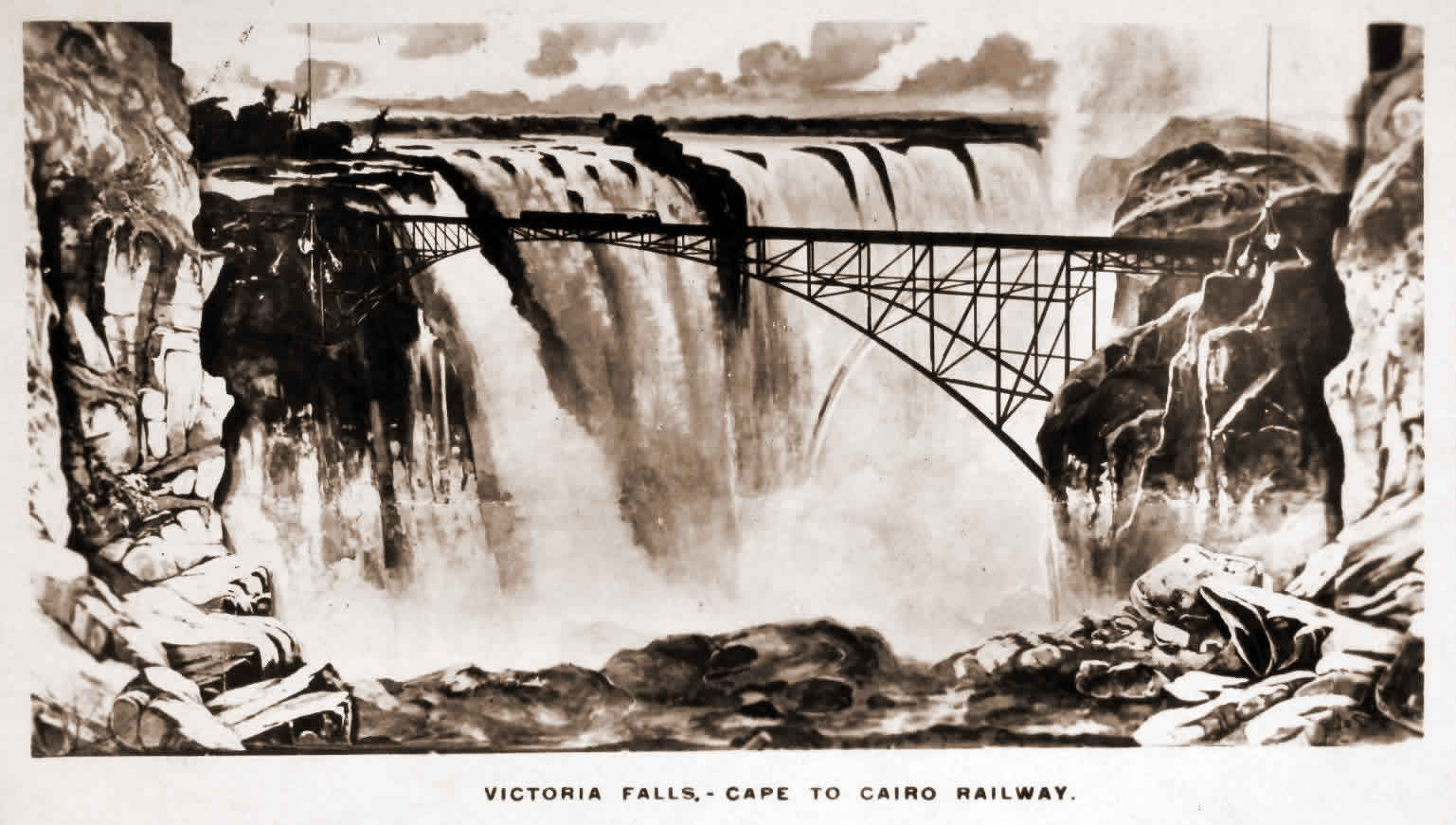
An early artists impression of the Bridge, with the Main Falls in the background
Construction Contracts
In mid-1901 the route of the railway extension covering 280 miles (450 km) to the Zambezi was agreed, the line travelling from Bulawayo to the coalfields and then on to the Victoria Falls, crossing the Zambezi River immediately below the Falls. The work was contracted in three successive sections, each awarded to Pauling’s construction company, with Harold Pauling again overseeing the work and Mr Stephen F Townsend as Chief Resident Engineer for the Railway Company.
The contract for the first part of the route, the 161 mile (259 km) of line from Bulawayo north to Mambanje, was agreed in July 1901 at a construction cost of £800 per mile. At the time, however, the Second Anglo-Boer War was still raging to the south, disrupting movement of materials and delaying the construction of the line.
The railway ran through sand veld, well wooded with mopane (Colophospermum mopane) and teak (Baikiaea plurijuga) trees, and with the exception of two river crossings was fairly easy going for Pauling and his men.
“Work began in 1901 on the first 161 miles [259 km] of easy going to Mambanje, which it was hoped would be reached in eighteen months’ time. This line ran through sand veld, well wooded with mopani and teak, and with the exception of the vicinity of the Umgusa River was of easy grading. As elsewhere, 60 lb. [27.2 kg] round-top rail was laid on steel sleepers, while the two main bridges over the Umgusa River were substantial steel and masonry structures.” (Croxton, 1982)
An Interview with Mr Townsend
In July 1901 the Bulawayo Chronicle published a detailed interview with Mr Townsend on the line to the Falls.
“In the course of an interview with Mr S F Townsend, a representative of the Chronicle endeavoured to obtain a more detailed statement than has hitherto been published, with regard to the resources which the line to the Falls is likely to develop... The length of the line from here to the Falls will be 275 miles [422.5 km]. The present idea as to the location of stopping places is to place stations, or rather sidings, every 20 miles [32 km], but later on stations and sidings will be added wherever the development of traffic shows it to be necessary.”
After connecting the stone quarries at Pasepas, 13 miles (21 km) out of Bulawayo, and traversing the agricultural district of Nyamandhlovu, before entering extensive areas of teak woodland.
“‘Then,’ said Mr Townsend, ‘the line goes into the great teak forest, about 40 miles [64 km] after leaving Nyamandhlovo. We hope to use this teak very largely for railway sleepers and other purposes of railway construction. We have already given out contracts for 25,000 sleepers as a beginning, and this order will probably be largely increased before long. The contractors are already at work on this first lot. I expect that this wood, once railway transport is available, will be largely used for mining timber, for buildings, &c, anywhere, in fact, where strong timber impervious to the white ant is required...’
“‘If you look here,’ said Mr Townsend, pointing to a large map on the wall, ‘you will notice that they only show the forest to the right of the line, but as a matter of fact, the whole of this big stretch of country to the left is covered with forest. For practical purposes it can be termed inexhaustible...’
“The railway then reaches the Wankie Coalfields, striking them first at a distance of 160 miles [257.5 km] from Bulawayo. The line passes through the centre of them, right past the main shaft. ‘It is equal to, if not better, than the best Welsh coal, is found extensively in rich, thick seams from 7 to 80 feet [2.1-24.4 m] in width, with an almost entire absence of shale in the coal...’
“After the first 160 miles [257.5 km] from Bulawayo, all the way to the Falls, the nature of the country makes very heavy work of the construction, what with big banks and cuttings, and rivers to be bridge. Once, however, the line is finished, it will be a very good one and a better one than the one south from Bulawayo...
“Contrary to previous statements, the Bridge at the Falls will be in one clear span from side to side of the chasm. It will be about 600 ft. [182.8 m] long, with the water running below at the enormous depth of 470 ft. [143 m] and only some 200 ft. [61 m] below the Falls. The trains will run right into the mist, ‘but,’ as Mr Townsend said, ‘when we were there there wasn’t much mist about it, it was simply heavy rain...’
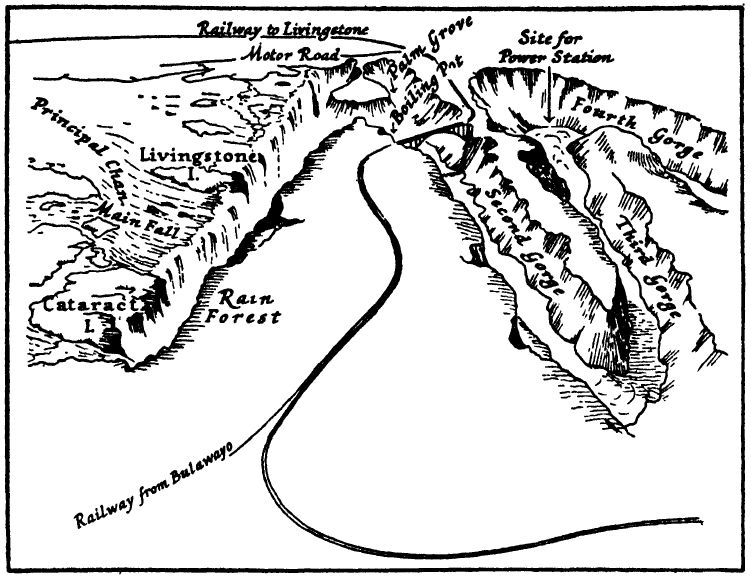
Sketch of the Victoria Falls showing position of the Bridge
(From ‘Some African Milestones’, Varian 1953)
“Soon after crossing the Falls Bridge the line by way of a gentle incline gets to the great Batoka plateau, which is very rich country, with plenty of natives, grain, cattle and game... So far as is at present known, the intention is to push right on to the north from the Falls without any delay. No contract has of course been given out yet for any portion of that extension. In fact, Messrs Pauling & Co have only got a contract for this first 160 miles [257.5 km] from Bulawayo, though it is understood that the contract for the remainder to the Falls will be let very shortly. Rich fields of copper ore are believed to exist some 800 miles [1,287.5 km] to the north of the Falls, and the reports of the experts sent up to examine these are waited. The line will be carried through the richest part, wherever that may be found to be. It will take about two years for the line to get to the Falls, so 300 miles [483 km] north of the Falls is quite far ahead enough for present consideration...
“‘What rate of progress do you expect in laying the line?’
“‘We can easily lay 25 miles [40 km] per month without any bother, if we get the stuff. That is really leaving a good margin; when we were building the line to Bulawayo we did as much as 40 and 50 miles [64-80 km] some months. Twenty-five miles [40 km] a month, you see, is about one mile [1.6 km] per working day. At that rate we should be at the Falls in 11 months’ time, but it is hopeless to expect that. With luck we ought to get there in two years, as we have never had any trouble at all in doing 25 miles [40 km] per month.’
“‘Northwards from the 160 mile [257.5 km] point the country is very rough, in fact it is no place for a railway at all, both on account of the hilly nature of the country and the number of rivers to be crossed. On the whole line there are 10 bridges, that is to say, bridges with several spans of 100 feet [30.5 m] each. The largest is the bridge over the Deka, 210 miles [338 km] from here, being about 400 ft. [122 m] long, or three-fourths the size of the Falls Bridge.’” (Bulawayo Chronicle, July 1901)
Construction Begins
Construction work on the line north began in early October 1901. Work on the line was, however, severely delayed due to lack of construction materials, the war in the south continuing to hinder transportation to the north.
“The laying of the rails of the new line to the Zambesi has commenced, and yesterday gangs of natives were busily engaged in trolleying the long steel rails down the incline leading to the rifle-range. About half a mile has been completed, and doubtless tomorrow will see some [similar] distance finished. There are 15 miles [24 km] of railway material here, which will be used for the Falls line, and it is to be hoped now that a start has been made, considerable progress will be made by the end of the year.” (Bulawayo Chronicle, October 1901a)
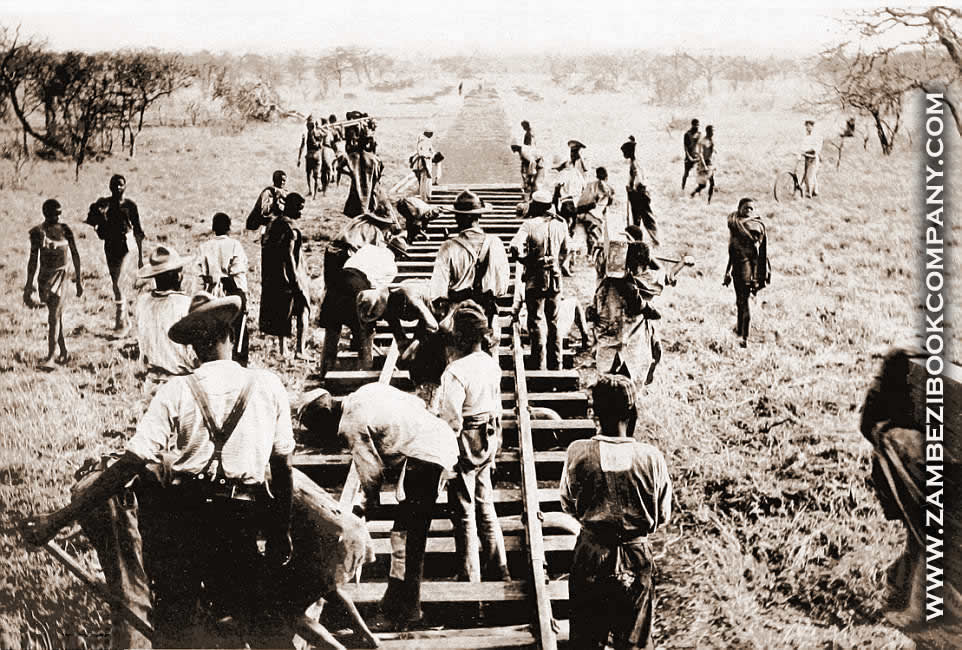
Laying the lines, Bulawayo to Victoria Falls
Later the same month Mr Townsend updated the Bulawayo Chronicle on progress - or lack of it.
“‘From this end no work is being done on either the Salisbury or Gwanda lines. As regards the Victoria Falls line, about a mile of construction material leaves the coast per week, and although it does not reach us as regularly as it leaves, still it does manage to get up. I hope this rate will very soon be increased; the military, I’m glad to say, hold out hopes of being able to increase the supply shortly. Of course, we can do anything up to a mile a day if we had the stuff and wanted to do it. But it’s no use, as you can understand, taking on a large staff of natives, gangers, etc, when we’ve only got a small amount of material. It is much better, and means really no delay to stack the stuff as it comes up, until we’ve got 30 or 40 miles [48-64 km] in hand. That amount can be quickly and economically laid...’
“‘The earthworks on the Victoria Falls line are out about 40 miles [64 km]; the rails are only out 4 miles [6.4 km].’
“Asked whether he had anything to say about his trip to Mafeking, the Resident Engineer said that the Boers are extremely troublesome along the line, and are continually blowing it up. They don’t do much damage, however, and they are only in very small parties.” (Bulawayo Chronicle, October 1901b)
Mr Townsend reported that the Railway Company was in the process of receiving delivery of 200 railway trucks and 11 engines in the south, with which it was hoped to expedite the transport of construction materials.
“‘Well, some time since, the Company, seeing the supply of trucks was so short, ordered another 200 of the Lancaster Railway Carriage and Wagon Company, the same company that constructed the train de luxe. They are ultimately intended for the coal traffic, having a capacity of 30 tons. These have now all been landed, and are in use on the various lines in South Africa. Rhodesia is, of course, enjoying the benefit of the increase, though only a small proportion of the trucks themselves are on this route. The same for 11 engines, of a powerful type, of the same type indeed that are drawing the heavy goods trains up here.’” (Bulawayo Chronicle, October 1901b)
References
Bulawayo Chronicle (July 1901) Railway to the Falls. 17th July.
Bulawayo Chronicle (October 1901a) Victoria Falls Line. 9th October.
Bulawayo Chronicle (October 1901b) Progress of the Railways. 30th October.
Croxton, A. H. (1982) Railways of Zimbabwe. David and Charles (Publishers) Ltd. [Originally published as Railways of Rhodesia, 1973].
Hobson, G. (1907) The Victoria Falls Bridge. Institution of Civil Engineers, Session 1906-1907, Part IV, Section 1. Minutes of Proceedings, 19th March. Paper No.3675, Volume 170, p.1-49.
Hobson, G. (1923) The Great Zambezi Bridge - The Story of a Famous Engineering Feat. [In Weinthal, L. [Editor] (1923), Vol.II]
Prince, A. T. (1906) Bridging the gorge of the Zambezi. The World’s Work, Vol.12, No.2, June, p.7637-7647. Doubleday, Page & Company, New York.
Rhodesia Railways Magazine (July 1955) Fifty Years - The Story of a Bridge (Part 1). Vol.4, No.3, p.21-23. [BRMA]
Rhodesia Railways Magazine (August 1955) Fifty Years - The Story of a Bridge (Part 2). Vol.4, No.3, p.21-23. [BRMA]
Rhodesia Railways Magazine (November 1965) Story of a Bridge 1905-1965, A Diamond Jubilee. Vol.14, No.7, p.11-13.
Roberts, P. (2021) Sun, Steel & Spray - A History of the Victoria Falls Bridge. Forth Edition. Zambezi Book Company / CreateSpace Independent Publishing. (First published 2011, Victoria Falls Bridge Company, Zimbabwe).
South Africa Magazine (April 1905) Zambesi River Bridged at Last, 8th April.
The Illustrated London News (May 1901) The Progress of the Cape to Cairo Railway, 18th May, p.707.
Varian, F. H. (1953) Some African Milestones. George Ronald, Wheatley.
- Go back to the feature section index.
Now available to order through Amazon UK/US sites.

The author can order copies for overseas orders outside of these areas (and with discounts for multiple copies) - please see the Contact Us page.