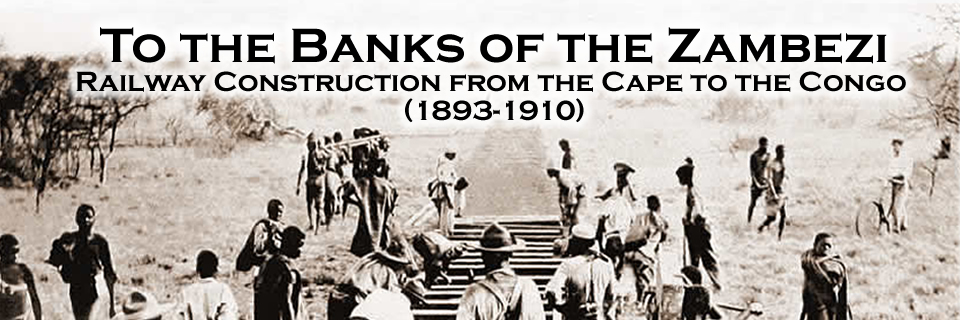
To The Banks of the Zambezi and Beyond
Railway Construction from the Cape to the Congo (1893-1910)
The following extended feature is adapted from 'To The Banks of the Zambezi and Beyond - Railway Construction from the Cape to the Congo (1893-1910)', researched and written by Peter Roberts and first published in 2021.
Bulawayo or Bust
With the cost and logistics of transport crippling the town’s trading economy, the settlers in Bulawayo increasingly demanded the speedy arrival of the railway to end to their isolation.
“It was not until 1896, after the Matabele rebellion and after rinderpest had caused such ravage amongst the cattle of the country, that freight from Mafeking to Bulawayo, a distance of 600 miles [965.5 km], was costing £200 a ton, that Mr Rhodes at last saw that railway communication was an absolute necessity; he therefore sanctioned the construction of the extension of the... railway to Bulawayo.” (Metcalfe, 1916)
Rhodes arrived at Bulawayo on 2nd June 1896, making a speech promising the arrival of the railway by the end of 1897 - and sooner if possible.
“Two years from date, Mr Rhodes said that the line would be in Bulawayo, but he made a better promise than this and that was that the Cape Railways could land the material for the line at the rate of a mile a day, and the Company would construct the line as fast as the railway could land material. This is the rate the people must ask for. Mafeking by the new route which the railway is to take is not more than five hundred miles [804.6 km] from Bulawayo; forty-five miles [72.4 km] have been constructed, leaving roughly four hundred and fifty [724 km] to be built. This is the rate of a mile per diem will not absorb two years but only fifteen months, and if a month or two are thrown in for contingencies the railway should be in Bulawayo by Christmas 1897.” (Bulawayo Chronicle, June 1896)
Rhodes gave instructions to George Pauling that the rails must reach Bulawayo as rapidly as possible, offering the contractors an extra £200 per mile to lay a mile of rails a day (Knight, 1900). In his autobiography Pauling recalled his reply:
“The total rail distance from Mafeking to Bulawayo is about five hundred miles, and I had told Mr Rhodes that, given a free hand, I would undertake to get the rails through for the last four hundred miles [644 km] of the distance within four hundred days.” (Pauling, 1926)
In 1895 George Pauling had accepted the post of Commissioner of Public Works for the new territory south of the Zambezi, further increasing the pressure on him to deliver the promised rails in time.
“George Pauling had been persuaded by Rhodes to take office as commissioner of public works in the administration of Southern Rhodesia - the three areas of Matabeleland, Mashonaland and Manicaland had been joined together - under Dr Jameson as Administrator. In his new capacity Pauling was placed in charge of all roads, public buildings and railways, as and when they were constructed, while later he also had mines and posts under his control.” (Croxton, 1982)
Pauling was interviewed in late June 1896, highlighting the shortage of construction materials as the limiting factor in the progression of the line.
“Interviewed on 20th June on the subject of railways, Mr George Pauling, Commissioner of Public Works, stated that about 2,000 people were employed upon the works between Mafeking and Gaberones and that the thing that would hinder the line was the inability of the Cape Government to transport the material as fast as required. Men were standing for the want of material. He forecast that the railways would be in Gaberones by the end of July, at Palapye by the end of the following February, and in Bulawayo by the end of December 1897. He added that the contractors were under heavy penalties to complete the work in the time stated.” (Bolze, 1968)
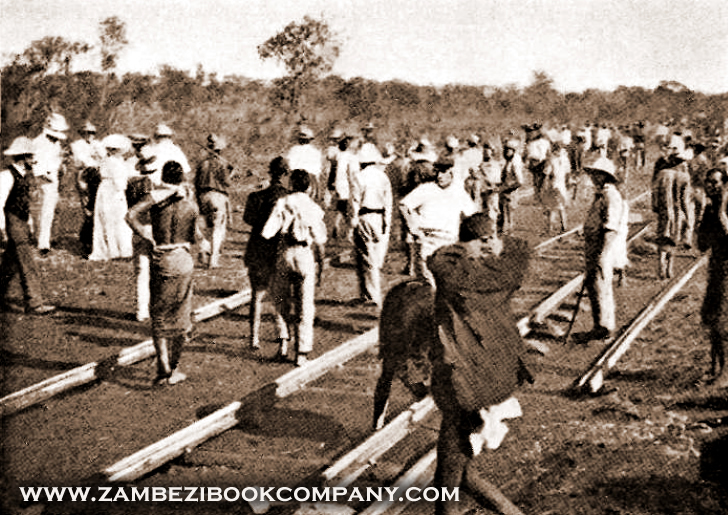
Track-laying, Palapye
From the End of the Rails
From the end of 1896 Mr Townsend established temporary offices and quarters for his field staff at Mochudi, sending regular updates on the progress of the rails to the Bulawayo newspapers and counting off the mileage to the ‘end of the rails.’ The regular weekly reports also highlighted progress on the surveying of the route, clearing of bush and preparation of embankments, completion of ballasting, the building of sidings, erection of station buildings and engine sheds (at Mochudi and later also Palapye), construction of temporary bridges, drilling of boreholes and construction of holding dams.
In November 1896 the Railway Company announced the first regular weekly train service from Mafeking through to Mochudi, the then temporary terminus of the railway, although still under contract conditions.
“The Cape Argus is authorised to state that the Bechuanaland Railway Company are making arrangements for the despatch, from an early date, of one regular train per week from Mafeking to the temporary terminus at Mochudi, some 120 miles [193 km] northward. This train will fit in with the weekly mail to Mafeking, and carry not only passengers and mail but goods. The number of trains well be increased as wagon transport becomes available from the terminus northwards.” (Bulawayo Chronicle, November 1896a)
At the beginning of November the rails had reached 157 miles (252.6 km) from Mafeking, 34 miles (54.7 km) north of Mochudi, with water still in demand (Bulawayo Chronicle, November 1896a). By mid-November the rails had progressed to the 168 mile (270 km) mark, the lack of progress again attributed to shortage of materials - the all important connecting fish-plates (a metal bar that is bolted to the ends of two rails to join them together) having been “loaded in England at the bottom of the cargo, and ten days rough weather at Port Elizabeth prohibited discharging” (Bulawayo Chronicle, November 1896b).
Towards the end of November the rails had reached 173 miles (278 km) from Mafeking, the delay now attributed to general lack of permanent way materials. The surveying party had reached the Monarch Mine - soon-after to give rise to the settlement of Francistown - having staked the route of the rails to the 360 mile (579 km) mark (Bulawayo Chronicle, December 1896).
River Crossings
Because of the need for urgency and the restrictions on cost the terms governing construction were not very exacting. They were that the line should “be capable of effectually conveying traffic at a speed of twelve miles [19 km] an hour on completion,” and that gradients and curves were not to be sharper and heavier than usual for a line of this gauge. Wherever the surface of the ground was even it was followed, the steel sleepers being packed with the minimum of ballast. Ballasting was to be used only on those parts of the line where it was necessary to ensure safety during the rainy season.
Streams were crossed by the erection of ‘birdcage’ or trestle bridges of timber. Wider streams and rivers, which usually had dry sandy beds except when flowing, were initially not even bridged, the line being taken across over a ford. Sometimes the water rose above the rails and the train would proceed carefully down the bank and send up a shower of spray when it ran into the water. The line was later improved and the fords were replaced by steel bridges.
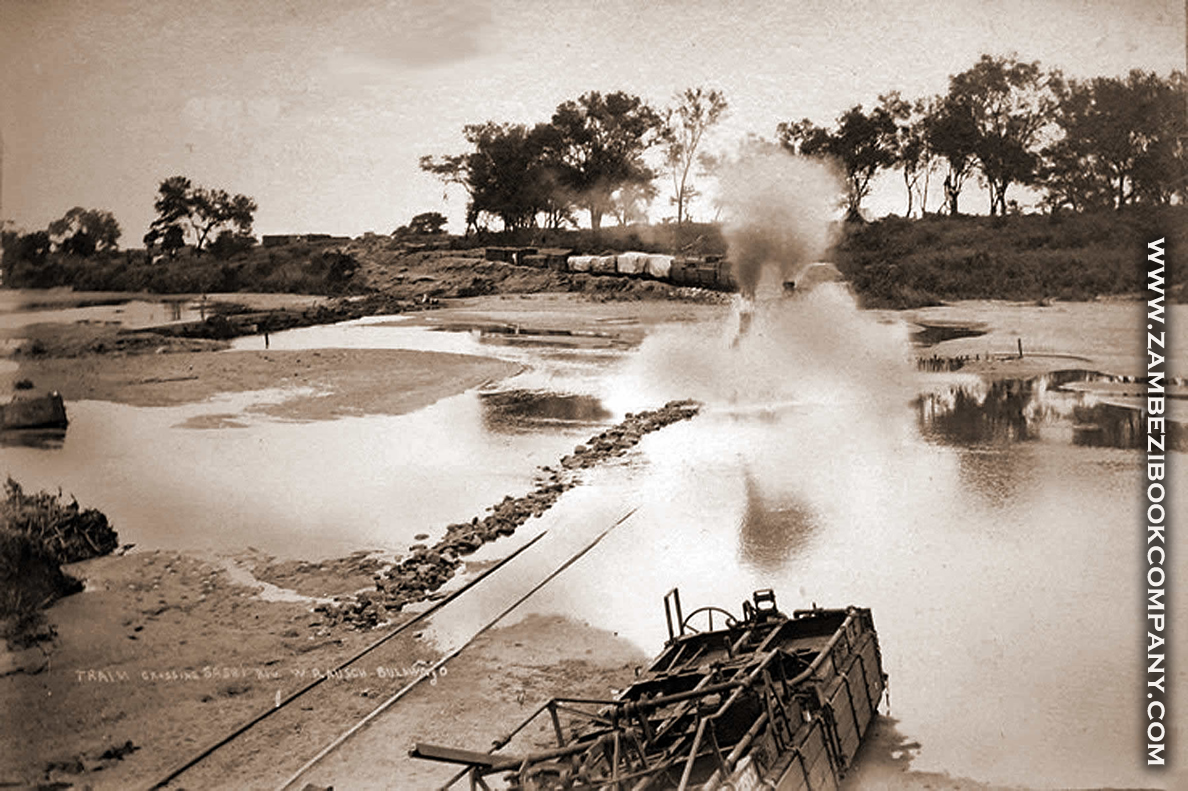
Crossing the Shashi River, 1897.
An advancing train sends a shower of spray into the air.
From the End of the Rails
Mr Edward M Rosher, assistant engineer reporting to Mr S F Townsend for the Railway Company, later recalled his work as a pioneer railway engineer.
“Mr Rosher made his debut in this part of the world on the survey of the line from Tati, in Bechuanaland, to Bulawayo in advance of the George Pauling construction gang. This section was built at top speed, at such a pace, in fact, that temporary tracks were laid on the sandy beds of the Shashi and Tati rivers until such time as bridges could be erected, work with which Mr Rosher was closely connected...
“In those days it was the practice to erect birdcaging to support long wooden trestles over the smaller rivers and these, in turn, would later be replaced by proper trestle bridges. Later, as time permitted, the trestle bridges gave way to more permanent structures with stone abutments, piers and steel girders.” (Rhodesia Railways Magazine, October 1965)
Line Logistics
In May 1897 Mr J L Bissett was appointed General Manager of the Bechuanaland Railway Company. Bissett had joined the Cape Government Railway in 1881 and promoted to goods superintendent and stationmaster at Kimberley in 1889.
“From June onwards references, in various contexts relative to railway rates, sole advertising rights, refreshment room leases and cartage rates, are made to Mr J L Bissett, General Manager, Bechuanaland Railway Company Ltd, who appears to have had his office in Cape Town. His was the first appointment to the General Managership of the railway serving Rhodesia.” (Bolze, 1968)
At the same time the Railway Company entered into an agreement with the Cape Government Railways to work the entire line from Vryburg to Bulawayo, taking over sections from the contractors and providing the staff for traffic, maintenance and locomotive purposes (Croxton, 1982).
“On 28th May an agreement was entered into between Sir James Sivewright, on behalf of the Cape Government, and Rhodes on behalf of the Bechuanaland Railway Company Ltd, providing for the Cape Government to work and maintain the line of railway belonging to the Company between Vryburg and Bulawayo. The agreement provided that the Government and the Company should each fix the rates applicable to its own lines and the rate for through traffic. The Bechuanaland Railway Company Ltd further agreed to erect at Mafeking suitable workshops for ordinary running repairs of the rolling stock required for working the line.” (Bolze, 1968)
In mid-1897 the Cape Government Railway advertised ‘Cape Town to Bulawayo in 5½ days,’ with a first class fare from Cape Town to Palapye of £13 10s, and second class £8 16s 10d. From Palapye, a Zeederberg coach would take passengers on to Bulawayo, the fare being £12 (Croxton, 1982).
“The coach journey was over rough roads behind a team of ten mules and this service was operated by the famous Doel Zeederberg. Luggage up to 30 lb. [13.6 kg] was allowed for free, this being carried on the roof of the coach.”
The section between Mochudi and Palapye, covering 140 miles (225 km), was officially opened on 1st July 1897, and the line from Palapye to Francistown, 101 miles (162.5 km), opened on 1st September 1897.
“By 1st October the rail journey had been extended to Francistown, with a daily coach to Bulawayo at a fare of £7.” (Croxton, 1982)
Services for travellers were basic, with the emphasis being on self-sufficiency.
“No food could be obtained on trains, which stopped at stations such as Lobatsi, Mochudi and Mahalapye where there were refreshment rooms, while at a few points small hotels near the line offered some sustenance. Rugs, pillows and water bottles were necessities for rail passengers in those days.” (Croxton, 1982)
In July it was announced that the grounds of the Bulawayo Athletic Club (B.A.C.) would soon become the terminus of the line and site for the goods and passenger station buildings. The site had previously been the training ground of Lobengula’s feared warrior battalions. Being cleared of trees and flat, it was the ideal location.
“After two months of uncertainty, it has at last been definitely settled to build the railway station on the B.A.C. grounds. It is certainly a pity that such a magnificent site should be lost as a recreation ground: but business before pleasure, and that the situation is in every way most suited for railway requirements can hardly be disputed. The committee of the B.A.C. were to meet Mr Rhodes this morning, and no doubt another club ground site will be forthcoming.” (Bulawayo Chronicle, July 1897)
To facilitate the development Rhodes bought the land with a personal cheque for five thousand pounds (Jones, 1997).
References
Bolze, L. W. (1968) The Railway comes to Bulawayo. Rhodesiana, No.18, July, p.47-84.
Bulawayo Chronicle (June 1896) Mr Rhodes and Railways. 6th June.
Bulawayo Chronicle (November 1896a) Railway Progress, 7th November.
Bulawayo Chronicle (November 1896b) Railway Progress, 21st November.
Bulawayo Chronicle (December 1896) Railway Progress, 12th December.
Bulawayo Chronicle (July 1897) The Railway Stations. 10th July.
Croxton, A. H. (1982) Railways of Zimbabwe. David and Charles (Publishers) Ltd. [Originally published as Railways of Rhodesia, 1973].
Jones, D. (1997) 100 Years The Railway in Zimbabwe 1897-1997. Pangolin Press, Harare.
Knight, J. H. (1900) The Cape-To-Cairo Railway. The Engineering Magazine. Vol XIX, No.1, April 1900, p.1-18.
Pauling, G. (1926) Chronicles of a Contractor, Constable. [Reprinted 1969 Rhodesia Reprint Library Vol.4, Bulawayo. (Edited by David Buchan)]
Rhodesia Railways Magazine (October 1965) At the Turn of the Century - The Railways Sixty-Five Years Ago. Vol.14, No.6, p.17 and 49. [BRMA]
- Go back to the feature section index.
Now available to order through Amazon UK/US sites.

The author can order copies for overseas orders outside of these areas (and with discounts for multiple copies) - please see the Contact Us page.