Corridors Through Time
A History of The Victoria Falls Hotel
The following text is adapted from 'Corridors Through Time - A history of the Victoria Falls Hotel ', researched and written by Peter Roberts and first published in 2016 (updated fourth edition published December 2024).
Pierre Gavuzzi
Pierre Gavuzzi became the first general manager of the Victoria Falls Hotel in mid-1904, travelling by train from Bulawayo to the Falls in late May with several truckloads of building materials destined for the construction of a modern hotel overlooking the rising spray of the Falls.
The Railway Company had leased the operation and management of the new Hotel to the Bulawayo business partnership of Mr G Estran and Mr W Scott-Rodger, managers of The Grand Hotel, Bulawayo, who transferred their manager, Mr Gavuzzi from Bulawayo to oversee the establishment and operation of the new Hotel at the Falls.
Fellow Italians, Estran and Gavuzzi appear to have met whilst working under César Ritz and Auguste Escoffier at the acclaimed Savoy Hotel during the 1890s. Both also men trained in France, during which time Gavuzzi appears to have adopted the name Pierre, being born Pietro Carlo Gavuzzi at Urbignano in Monticello, Italy, in 1870.
From Italy to London
In 1882 Pietro left his hometown to work at his uncle's restaurant in Turin, where one day he served a particularly demanding customer - a man who turned out to be the famous French chef Auguste Escoffer, and who offered the young Gavuzzi the opportunity to work under him in Paris.
"Pietro Gavuzzi (1870-1945) was born in Monticello Villa into a peasant family. He left the village in the autumn of 1882, with a few coins in his pocket and a loaf wrapped in a handkerchief... The goal of his first trip is a restaurant in Turin, in Piazza San Carlo at the corner with Via Santa Teresa, at the time run by an uncle. Here he begins his apprenticeship... until one day he has the opportunity to serve a particularly demanding customer: Auguste Escoffier. The famous French chef, seeing the grace and sensing the boy's talent, wants to take Gavuzzi with him and the uncle does not resist, on the contrary, he is happy because he has one less person to support." (Olivero, 2012)
After training as a chef in France Gavuzzi relocated to the fashionable Savoy Hotel in London, opened in 1889 and from 1890 under the management of César Ritz with Auguste Escoffier as chef de cuisine. The Hotel, and its restuarant, quickly became the most fasionable in London, attracting a distinguished and wealthy clientele, including His Royal Highness Prince Edward, The Prince of Wales (eldest son of Queen Victoria and later to become King Edward VII).
Ritz and Escoffier left the Savoy after several successful years, in 1897, the pair transferring to the newly opened Carlton Hotel in 1899, and taking many of their staff, and fashionable clientele, with them. By 1898 Gavuzzi is recorded as managing his own restaurant in London (Stewart, 2010), although Estran appears to have continued working for Ritz at the Carlton (Creewel, 2004).
On 3rd August 1898 Gavuzzi married Ada Elizabeth Sletcher (born 3 Sept. 1872 at Renhold near Bedford, England) at St. Martin in the Fields, London. Their first child, Ada Carolina (Lina) Gavuzzi, was born on 3rd December 1899 in London.
The Grand, Bulawayo
By 1901 Estran had relocated to Bulawayo, where he entered a partnership with Mr W Scott-Rodger in the operation and management of the Grand Hotel (opened in 1898) and soon after invited Gavuzzi to Rhodesia to become the Hotel's manager.
"Mr Gaetano Estran was born in Italy and had received his training in Cannes under the famous hotelier of the day, Charles Ritz. Having held positions in a number of leading European hotels, latterly the Carlton, he arrived in Rhodesia in 1901. He persuaded a countryman of his [Gavuzzi] to join him to run the Victoria Falls Hotel, as well as the dining car system for the Beira and Mashonaland and Rhodesia Railways." (Creewel, 2004)
Gavuzzi was a popular character and famed locally for his fine strawberries (grown on a plot of land which would later become the Prince’s Theatre), encouraging his patrons to dine to live music and introducing table-tennis, in the form of ‘ping-pong,’ to Rhodesia - presumably much-needed entertainment for his guests.
“He soon had Bulawayo talking about the excellence of his cuisine and before long it not only became fashionable to attend banquets at The Grand, but the ‘Bulawayo Chronicle’ would also publish the menu in full the following day.” (Rhodesia Railways Magazine, December 1954)
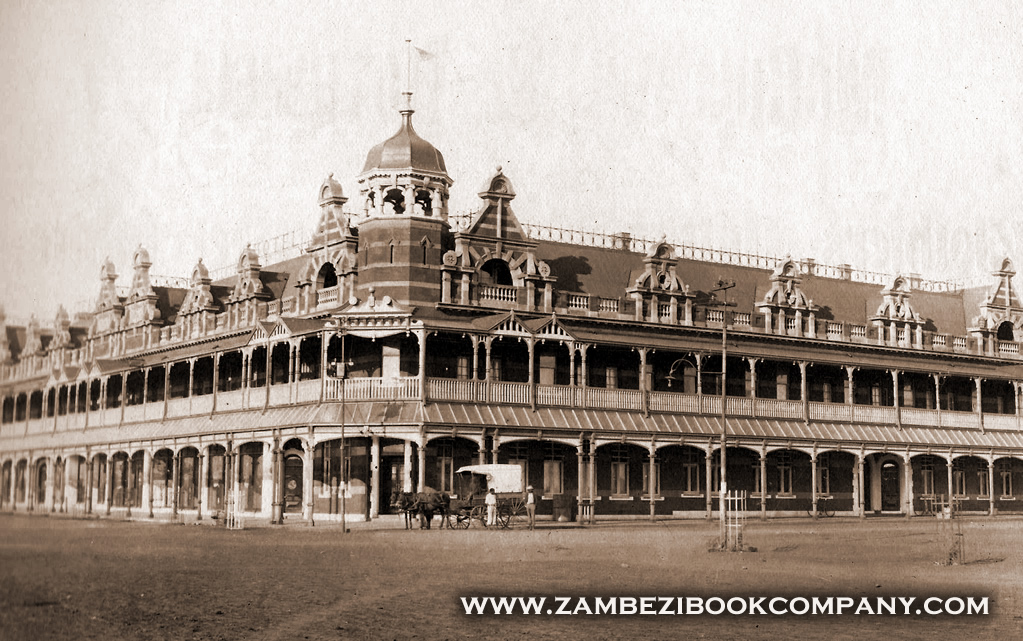
The Grand Hotel, Bulawayo, c1900
Bulawayo residents were glad to learn, therefore, that they were not loosing Mr Gavuzzi permanently to the Falls, as he remained manager of The Grand.
“M Gavuzzi has gone to the Falls, but he is not leaving us for good. He will still retain the management of the Grand Hotel, Bulawayo; in his absence, Mr G Esteron [presumably a miss-spelling of Estran], who has learned his business under M Gavuzzi during the past ten years at the Carlton and Savoy Hotels, London, will represent him, and be in charge. But we cannot afford to lose our South African Ritz, even though he may be extending his operations further north and popularising a coming hotel as he has done here. He will return in a couple of weeks, when he will be arranging to meet some 40 tourists from the Cape to take them to the Falls.” (Bulawayo Chronicle, June 1904)
The family probably remained living in Bulawayo with Ada giving birth to their second child, Giacomo Gavuzzi, in Bulawayo on 11th June 1905.
The Victoria Falls Hotel
Gavuzzi guided the development of the Hotel, which he referred to as a simple 'hostel,' during its critical early years. The early Hotel staff were cosmopolitan in origins - Mr Gavuzzi was Italian, the chef French, and the barman from Chicago, with service supported by Indian waiters. The young chef, Mr Marcel Mitton, known as ‘the Frenchman who became a Rhodesian,’ would become a famous figure in early Rhodesian history, trying his hand as a hunter and miner as well as a chef.
“The management will be under the direct supervision of M Pierre Gavuzzi, of the Grand Hotel, Bulawayo, and he will have a staff of competent assistants, trained under him. A first-class French chef, a Chicago barman, Arab waiters and white attendants will be found at this hotel. The cuisine will be as fine as experience can make it... Electric light is being installed throughout. Each of the tables in the dining room will be lighted by separate standards, so as to lend a softness to the illumination of the room. Refrigerators, cold chambers and ice will certainly be appreciated in the climate of the Victoria Falls, and will allow of the finest meat and vegetables being kept for the table. Bathrooms with beautiful fixed baths, with hot and cold water, will also be found in this latest example of Rhodesian enterprise and to counteract any great heat in the summer, electric fans will be running to cool the atmosphere.” (Bulawayo Chronicle, June 1904)
An area of the land beyond the Railway Station was developed into the Hotel’s farm gardens, managed by Mr Gavuzzi with the aim of supplying fresh produce for the kitchens, and again growing his prized strawberries.
“In the gardens are melons, pines [pineapples], tomatoes, tobacco, asparagus, beans, peas, potatoes, cucumbers, celery, lettuce, weighing 6½ lbs. (salade romaine), radishes, and strawberries, while there are 4,000 cabbages, some weighing 18 lbs. [over 8 kg]... Mr Pierre Gavuzzi was never at rest, and was a tireless worker for the comfort of his guests.” (South Africa Handbook, 1905)
Day trippers could order lunch hampers from the Hotel to be delivered to pre-arranged picnic spots around the Falls.
During the constructionn of the Victoria Falls Bridge (from late 1904 to September 1905) an outside bar, known to the railway workers and bridge engineers as the ‘Iron and Timber,’ was provided at the Hotel, and soon became the social hub of the transitional community, with many an evening was described as ‘lively.’ Percy Clark expands in his autobiography:
“While the Bridge was still in course of construction an outside bar was put up for the workmen. They were a rough lot, even for the wilds, and they made the Hotel very uncomfortable for sedater guests in the main building, especially just after they got their monthly pay. At this time the Hotel was run by private management. The lessee was an Italian, and the antics of his customers, both heads and hands, kept him scared almost out of his wits... Whenever he came in sight of the workmen using the outside bar he was at once chased round the premises. If caught he was hauled into the bar and made to stand drinks all round. He did not relish this rough handling and had not the knack of taking it easily. He therefore gave the outside bar a wide berth, though he must have made a pile from it. For two or three days after the men received their pay the bar would be packed. Drinking and gambling went on continuously, with free entertainment day and night for anyone who cared for that sort of thing. There was always a fight going on outside the bar - and the workmen certainly could scrap. Fortunately for the management it had secured the services of an ex-prize fighter as barman. He was not a very big chap, but he stood no nonsense from the crowd.” (Clark, 1936)
Mr Gavuzzi appears to have fancied himself as an entertainer, it being recorded that for the opening of the Bridge “Gavuzzi added to the gaiety by singing Italian arias” (Green, 1968). This may account for his ‘popularity’ among the engineers.
“On one occasion when the whole gang was having a vary hilarious night of it in the Hotel bar Gavuzzi, who was small in stature, was hoisted up on the mantelpiece and obliged to sing a song.” (Croxton, 1982)
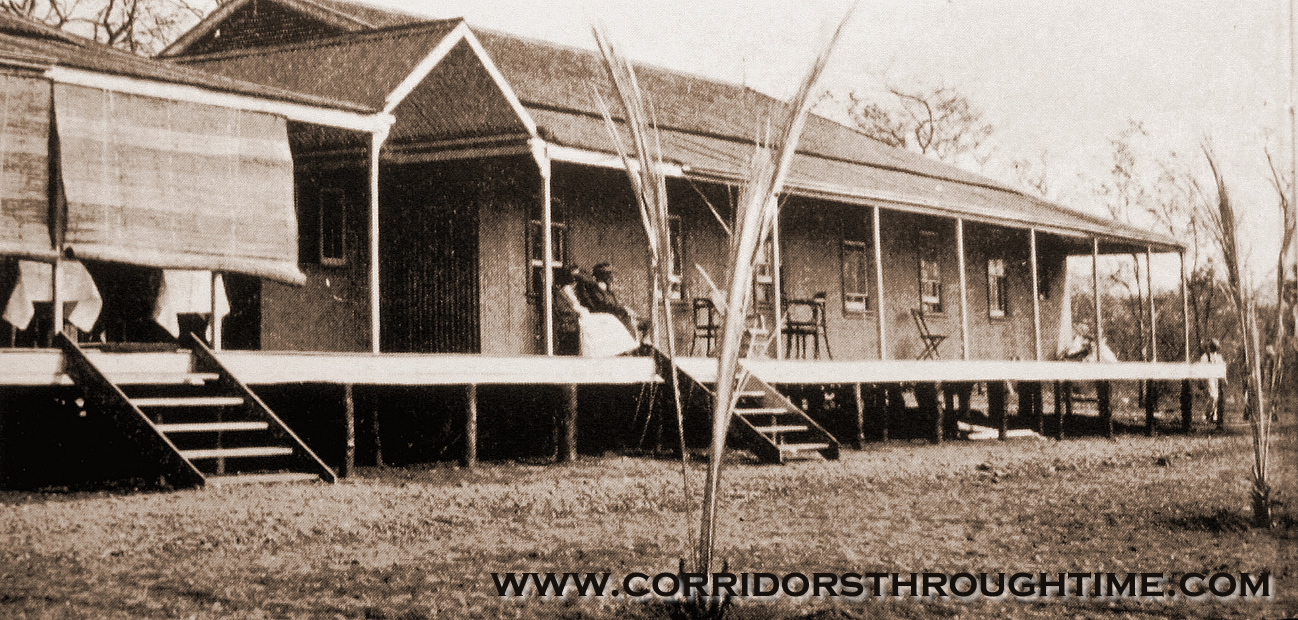
The Victoria Falls Hotel, c1904
Before leaving the Hotel Mr Gavuzzi had in December 1905 accepted the post of manager of the new Carlton Hotel, Johannesburg (modelled on the original Carlton Hotel in London and opened in February 1906) and for a while regularly travelled between the two hotels, before eventually moving permanently to South Africa. The partnership of Mr G Estran and Mr W Scott-Rodger, managers of the Falls Hotel and The Grand Hotel, Bulawayo, appear to have dissolved their partnership around the same time, with Mr W Scott-Rodger being identified in an advert as the sole proprietor of The Grand in September 1906 (Bulawayo Chronicle, September 1906).
In August 1906 Henry Holland arrived to take up duties as the new Manager of the Hotel, having previously been the Conductor on the Train de Luxe.
Later Life
Gavuzzi later worked in London and Argentina before retiring to Alba in Italy in 1920 (where he was apparently nick-named il milionario, 'the millionaire.')
"He later worked in the hotel business in London, and in Buenos Aires where he was manager of the Plaza Hotel (now the Marriott Plaza Hotel), one of the largest and most luxurious hotels in the city. He retired to Alba in 1920 and occupied the Villa Ada at nearby Serra, overlooking the city." (Stewart, 2010)
The family had four more children, born in Italy (1907), Argentina (date unknown, died in infancy) and London (1909 and 1910).
Ada died in Alba 7th November 1938.
Peitro 'Pierre' Carlo Gavuzzi died in Alba on 26th July 1945. The villa was sold to Dominican sisters in 1949 and redeveloped as a convent.
References
Bulawayo Chronicle (June 1904) Victoria Falls Hotel. 4th June.
Bulawayo Chronicle (September 1906) Advert, The Grand Hotel. 9th September.
Clark, P. M. (1936) Autobiography of an Old Drifter. Harrap, London.
Creewel, J. (2004) A history of the Victoria Falls Hotel - 100 years 1904-2004. Edited and updated by Stan Higgins. (Originally published in 1994 as A history of the Victoria Falls Hotel - 90 Glorious Years 1904-1994).
Croxton, A. H. (1982) Railways of Zimbabwe (Originally published in 1973 as Railways of Rhodesia).
Green, L. G. (1968) Full Many a Glorious Morning. Timmins.
Olivero, P. (2012) Memorie di galaverna - Storie inedite di camerieri e cuochi piemontesi tra Ottocento e Novecento. Online source.
Rhodesia Railways Magazine (December 1954) First Hotel Built in a Month. Vol.3, No.8, p.13.
South Africa Handbook No.34 (1905) A Trip to the Victoria Falls and Rhodesia. Winchester House, London.
Stewart, A. D. (2010) Gavuzzo & Gavuzzi: the history of a Piedmontese family from the Middle Ages to the twentieth century. Amelia, Italy 2010.
- Go back to the Hotel feature section index.